
NFL Price Boosts at UK Bookmakers: When They’re Genuine Value and When They’re Not
 Available in US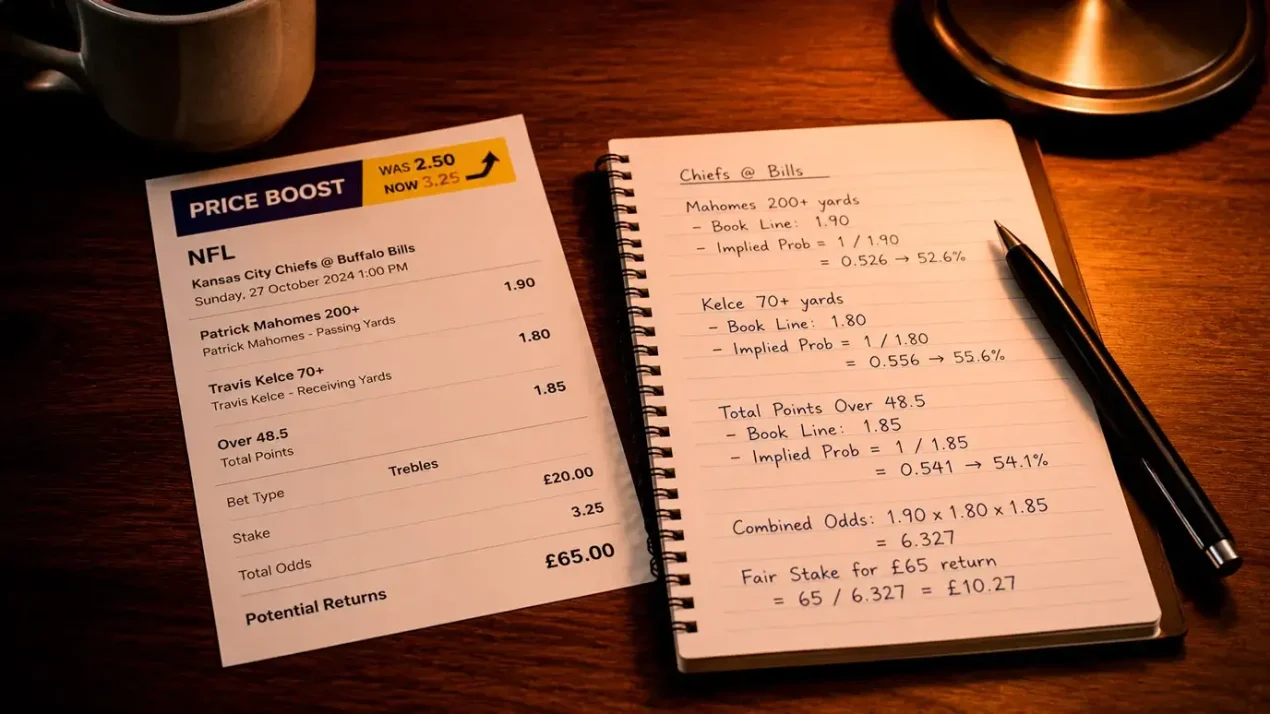
The boosted price that cost me twenty quid to learn from
The first NFL price boost I bet was a five-leg accumulator on a slate of Sunday games. The bookmaker had taken what would have been roughly 8/1 in the wild and boosted it to 12/1. I remember the satisfaction of feeling like I had been given free money. The legs lost on the third one. The lesson took me weeks to fully unpack. I had not asked the question that should have come before any analysis of the boost: was the original 8/1 price actually fair value? It was not. The legs were public favourites, the underlying probabilities did not stack to anywhere near 12.5%, and the boost was dressing up a bad bet in fancy clothes.
Price boosts are, broadly, a marketing product. They serve a marketing purpose. That does not make them inherently bad value, but it does mean the value question requires more work than the eye-catching banner suggests. The UK market has seen genuine growth in NFL engagement – Entain reported the number of British and Irish customers betting on the NFL grew 65% year-on-year following the 2024/25 season, with total stakes up 46% – and price boosts are one of the levers operators use to capture that growth. Knowing when to take them and when to walk past is a real skill.
How a price boost is actually constructed
A price boost typically starts with a market the bookmaker would have offered anyway at fair-margin pricing. The marketing team picks selections that look attractive – popular players, primetime games, narrative-driven matchups – and the trading desk reprices them at a more generous number. The boost is usually 5% to 25% above the standard price the same operator would have offered without the marketing layer.
That sounds like clear value, and sometimes it is. The complication is that the selections chosen for boosts are not chosen at random. They are chosen because they sell. The selections that sell are public-favourite outcomes – the headline QB on the headline team, the marquee anytime TD scorer, the popular parlay combination. Those selections, on average, are bet more heavily than their fair probability justifies. A 10% boost on a public-favourite price is sometimes still worse value than the unboosted price on the contrarian side of the same market.
The cleaner boosts, in my experience, come from boosts on individual prop lines rather than accumulators or specials. A boost on Patrick Mahomes anytime TD from +110 to +130 is a clean 18% improvement on a single market. The fair-value question is straightforward – does Mahomes score more than the implied probability of +130 (about 43.5%) suggests? If yes, the boost is value. If no, even the boosted price is not enough. The math is honest on single-leg boosts in a way that it is rarely honest on multi-leg specials.
The math you should actually run before taking a boost
The working calculation is simple. Convert the boosted price to implied probability. Compare that implied probability to your own estimate of the true probability. If your estimate is higher than the boosted-price implied probability, the boost is value. If lower, it is not. The boost size is interesting but secondary – a 20% boost on a price that was massively overvalued to begin with is still overvalued. A 5% boost on a price that was fair is now value.
To make this concrete: a boost from 2/1 (33.3% implied) to 9/4 (30.8% implied) is roughly an 8% boost in price terms. If you estimate the true probability of the event at 32%, the original 2/1 was a value play and the boost makes it sharper value. If you estimate the true probability at 28%, neither price is a bet – the original was overvalued and the boost is less overvalued but still not below your estimate.
The typical UK book offers a few daily price boosts on NFL fixtures during the season. Some of them clear my fair-value threshold; most do not. I treat the daily boost menu as a screening list, not a recommendation list. The screening question is “is the boosted price below my estimate of fair value”, and most of the time the answer is no. When it is yes, I bet. When it is no, I skip and move on. That discipline is the only thing that turns the boost product from a marketing engagement tool into a betting tool.
Super boost versus multi-leg boost
Most UK books run two structurally different boost products. The super boost is a single selection – usually one player prop or one match outcome – at a meaningfully enhanced price. The multi-leg boost takes a curated parlay of three to six legs and offers it at a boosted accumulated price.
The super boost is the friendlier product for serious bettors. Single legs are easier to evaluate, the fair-value math is direct, and the boost size on super boosts is often genuinely large – 25% to 50% improvements on the unboosted price are not unusual. The catch is that super boosts come with stake caps, usually £10 to £25, and once the cap is consumed the bookmaker reverts to standard pricing. The cap is there because the bookmaker knows the price is generous. They want exposure, not a 4-figure liability.
The multi-leg boost is structurally less friendly. The accumulator math compounds, so a 10% boost on a five-leg parlay is barely a meaningful improvement once you factor in the steep multiplicative book edge that parlays carry. Multi-leg boosts also tend to be built around public-favourite legs – narratives that sell to casual punters – which means the underlying selections are often overpriced before the boost is applied. I rarely play multi-leg boosts. When I do, it is when I have an independent thesis on the legs and the boost is simply discounting a parlay I would have constructed anyway. Henry Hodgson, NFL UK GM, framed the youth-driven growth of the UK audience after Super Bowl LVIII: “The viewership, combined with the social engagement through Super Bowl week, is a testament to the growth of the NFL in the U.K., particularly among the youth demographic that we’ve targeted this season.” That growth – younger, more digitally engaged punters – is exactly the audience that the multi-leg boost product targets. The marketing logic is real. The value math is harder.
Stake caps and the practical limit on boost value
Every meaningful price boost in the UK market comes with a stake cap. £10 is common. £25 is the upper end. The cap exists to limit the bookmaker’s downside on a price that is genuinely below fair value. The cap also limits the practical bankroll impact of even a perfectly-identified value boost.
The math here is important. A 15% boost on a £25 stake, on a market where the boost is clean value, is worth £3.75 of expected value over the unboosted price. That is real money in the long run, but it is not life-changing per individual bet. The serious value of boost-hunting is in the volume – finding several value boosts per week, every week, across multiple operators. The cumulative edge is meaningful. Each individual boost is a small adjustment.
The other practical limit is that some boosts are not bettable at full stake even within the cap. Operators sometimes apply a “boost token” model where you have to spend a token to access the boosted price, and you only get a few tokens per week. Other operators tie boosts to specific account tiers or wagering history. Reading the small print before relying on a boost as part of a betting plan saves frustration.
The boosts I find genuinely worth taking
The boosts that have most consistently passed my fair-value threshold are single-leg boosts on contrarian positions. A boosted price on a road underdog QB’s passing-yards over, in a game where my model says the script supports the over but the public is on the favourite. A boosted price on an alternative anytime TD scorer – the second receiver, the change-of-pace back – in a script where their role is structurally favourable. The selections that do not sell as well are the ones where the boost is most likely to be clean value.
Conversely, the boosts that almost never pass my threshold are anytime TD specials on the most popular skill players, headline QB passing-yard overs on primetime games, and multi-leg accumulators of obvious favourites. The market on those selections is already priced tighter than fair value because the public bets them heavily. The boost narrows the gap but rarely closes it.
What I do operationally: I check the daily boost menu Monday and Tuesday morning before the markets stabilise, when boosts are sometimes posted on lines that have not yet moved with the late-week sharp action. The same boost that is bad value on Saturday morning is sometimes acceptable value on Monday, before the line tightens. The window for boost value, like the window for general prop value, is mostly early in the week.
How do I calculate whether a boosted NFL price actually beats fair value?
Convert the boosted price to implied probability – for fractional 9/4 that’s 1 divided by (9/4 + 1), giving 30.8%. Compare that implied probability against your own estimate of the true probability of the event. If your estimate is higher than the implied probability, the boost is value. If lower, it is not. The boost size on top of the original price is interesting but secondary to whether the boosted price itself sits below your fair-value estimate.
Why do UK bookmakers cap stakes on enhanced NFL price boosts?
Because the boosted price is intentionally generous, the bookmaker is taking real expected-value risk on each accepted bet. A stake cap of £10 to £25 limits that exposure per customer and lets the bookmaker offer attractive marketing prices without taking a six-figure liability if a popular boost cashes across thousands of accounts. The cap is the structural reason boosts can be priced as well as they are.
The next operational question once you have a value bet placed is when to consider taking the bookmaker’s exit offer – explored in detail in my framework for when to take cash out on NFL bets.
This material was created by the YardLedger team.
Related posts

Passing Yards Prop Strategy for NFL: Reading Lines, Pace and Defensive Context
NFL RB Committee Prop Strategy: How to Bet Backfields That Refuse to Anoint a Workhorse