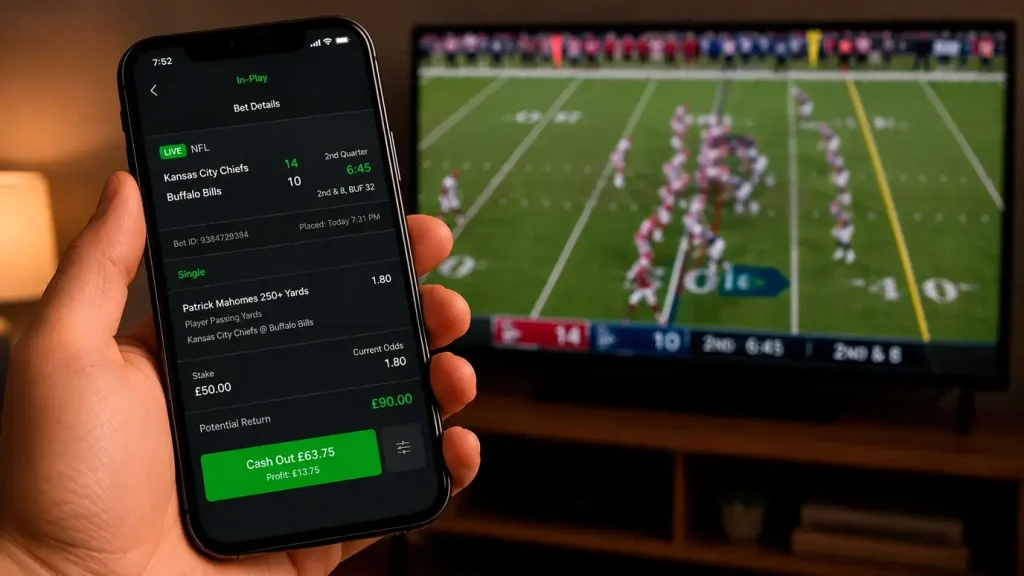
Passing Yards Prop Strategy for NFL: Reading Lines, Pace and Defensive Context
 Available in US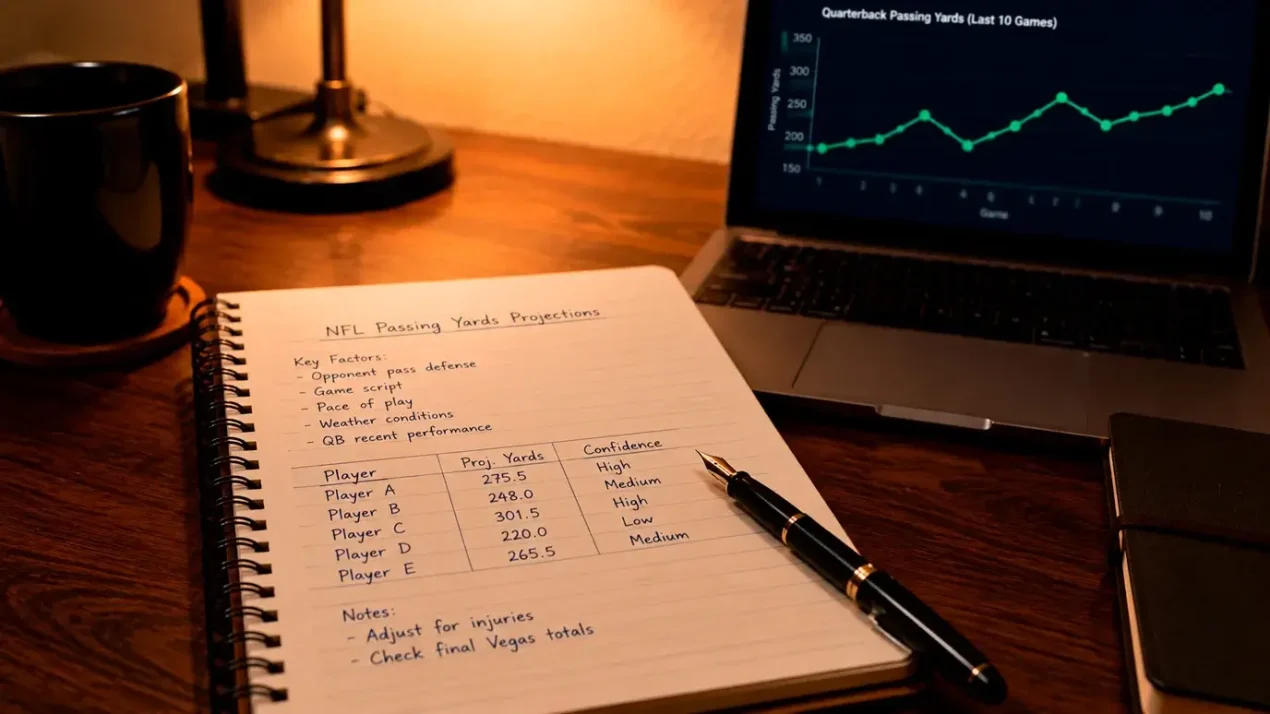
The line that taught me to stop trusting the season average
A QB I had watched all year carried a 280-yard passing-yards line into a divisional game. His season average was 295. The line looked like value on the over before I had finished my coffee. He threw for 197 yards. The reason was sitting in plain sight on his game log – he had played his last three games against bottom-eight pass defences, and the week ahead matched him against the second-ranked unit in DVOA. The season average had baked in a soft schedule that was about to end.
That bet, and several siblings of it, is what convinced me that the passing-yards prop is a context-driven market, not a stats-driven one. Season averages get most punters into trouble. The lines that print are the lines that read pace, script and defensive matchup against each other, and the work of finding edge is the work of reading those three signals more carefully than the bookmaker did.
Where the typical lines actually sit
UK bookmakers price QB passing-yards lines in a relatively narrow band. The starting range for a typical week-to-week starter is 250 to 300 yards, with elite passers in high-volume offences occasionally pushing into the 310 to 320 zone. The bottom of the QB tier – backups, run-first offences, rookie starters – see lines that can drop into the 195 to 230 range.
What is useful to know is how rigid these tiers are. Bookmakers rarely move a QB’s baseline more than 15 to 20 yards week-to-week, even when the matchup arguably justifies more. A 285-yard passer matched against a defence that has allowed 320 yards per game does not typically see his line pushed to 310. It moves to 295, maybe 300. The market is sticky on the high end, looser on the low end, and that asymmetry creates structural opportunities on overs against weak pass defences and structural traps on overs against strong ones.
The mid-tier – the 260 to 280 zone – is where most of the action happens and where the lines are sharpest. There is no easy edge in the middle of the distribution. That is where book pricing is best and public action is heaviest. The edges live at the extremes.
Game script is the variable everyone underestimates
Game script is shorthand for the way a game’s flow shapes play-calling. A team that is up by 10 in the second half runs more and throws less. A team that is down by 14 throws on almost every snap. The QB passing-yards line is implicitly betting on a specific game script, and when the actual script diverges, the line is exposed.
The most useful framing: a team installed as a 7-point favourite has a passing-yards ceiling that is meaningfully lower than the same team installed at pick-em. The favoured team is expected to be running the clock in the fourth quarter, not airing it out. I have seen seasoned punters lose money repeatedly betting overs on favoured QBs because the season-long stats look great while the closing game script erases the final 40 yards.
The contrary case is the underdog QB. A starter installed as a 3-point underdog at home, against a defence that allows decent yardage, in a projected close game, is a structurally favourable spot for an over. Most of his volume comes from the second half regardless of script, and if the script breaks his way – opponent leads – he is going to be throwing on most snaps. Books understand this. They price it. But the public still under-weights it, which means the closing line is sometimes generous on the underdog over.
Pace, plays and the volume layer
Pace of play matters because passing yards is a volume metric before it is an efficiency metric. A QB attempting 42 passes is overwhelmingly more likely to hit 290 yards than the same QB attempting 28, even if his per-attempt average is identical. Volume is downstream of pace, and pace is downstream of two teams’ tempo choices and game script.
Working data on offensive pace: when two top-ten pace teams meet, the combined game runs roughly 10% more offensive plays than the average matchup. That sounds small until you do the multiplication. Ten percent more plays for both teams, in a passing-leaning matchup, can mean an additional six to eight pass attempts for each QB. Six pass attempts at a typical 7.0-yard average is 42 additional yards. That is the difference between a 270-yard line going under and the same line going over by a healthy margin.
The reverse holds. Two slow-pace teams meeting produce a low-play environment that compresses passing-yard ceilings even when the matchups individually look favourable. I have learned to check both teams’ pace ranks before I take any opinion on a passing line, and the matchup-level pace is what matters, not the individual ranking on its own.
Defensive context is the leg most punters skip
Most prop bettors check the opposing defence’s overall yards-allowed-per-game. That is the wrong number. The right number is opposing pass defence yards per attempt, adjusted for the strength of recent opposing quarterbacks. A defence that has allowed 280 yards per game while facing five elite passers is doing fine. The same defence facing five mediocre passers is collapsing.
What I look for: pass defence DVOA, which adjusts for opponent strength; yards per attempt allowed, which strips out volume; and pressure rate generated, because pressure on the QB compresses yardage even when the secondary holds up. A defence that ranks bottom-ten in DVOA but top-five in pressure rate is harder to throw on than the surface stats suggest. The QB facing them is more likely to throw checkdowns and short outs, dampening the per-attempt average.
Cornerback matchups within the defence matter for individual receivers, but for QB passing yards in aggregate, the unit-level numbers are what move the needle. Sky Sports renewed its NFL rights ahead of the 2025/26 season and increased its UK coverage by nearly 50%, which means the average UK punter now has access to more film than ever. Laura Louisy, the NFL’s Director of International Business Development and Media, framed the renewal as a direct response to UK appetite: “We’re thrilled to extend our partnership with Sky Sports, with an increase in NFL coverage for fans in the UK.” More coverage means more film for prop bettors willing to watch defensive units rather than just box scores, and that is what separates a disciplined approach from guessing.
Weather, stadium and the unsexy variables
The variables that move passing-yards props that nobody likes to talk about are weather and stadium. Indoor stadiums favour passing slightly – controlled conditions, faster turf, no wind disruption. Outdoor stadiums in November and December favour the under, particularly in north-east and Midwest venues where wind speeds above 15 mph genuinely affect deep-ball completion rates.
Rain is more about the receivers than the QB. Slick balls and slick fingers reduce catch rates, which reduces yardage even when the QB is performing well. I treat rain as a soft under-leaning factor, worth maybe 15 yards of adjustment on a typical line, not a hard signal.
Cold by itself is not the issue. Wind is. A 28-degree Fahrenheit game in calm air is a fine passing environment. The same temperature with 20 mph gusts is a structural under. The market prices wind reasonably well, but the public sometimes overreacts to cold temperatures alone, which can leave value on the over when a clear, cold day shows up in the forecast.
What a working pre-bet checklist actually looks like
The framework I run through before placing any passing-yards prop comes down to five questions. What does the matchup-level pace tell me about volume? What is the implied game script given the spread and total? How does the opposing pass defence look on adjusted metrics, not raw yardage? What are the weather and stadium variables? And has the line moved meaningfully from open to current, and in which direction?
If four of those five point in the same direction, I am comfortable with the play. If three point one way and two point the other, the line is doing its job and I usually pass. If they all conflict, I am almost certainly looking at a market the books have already sharpened. The Pickswise season tracker landing on 59 winning player props with +7.7 units illustrates the discipline the format rewards: a small edge, applied consistently over many fixtures, beats trying to hit home runs on intuition.
At what point spread does a QB typically lose passing-yard upside as a favourite?
The pivot tends to sit around the 6.5 to 7-point favourite range. Below that, game script remains close enough that the favoured offence keeps throwing into the fourth quarter. At 7 points or more, the favoured team starts running the clock in the late stages, and the QB’s passing-yard line is structurally constrained. Lines on favoured QBs at 7+ points spreads are systematically harder to clear on the over.
Does cold-weather NFL betting favour passing yards unders or overs?
Cold by itself is not the meaningful variable – wind is. A cold game in still air is a perfectly fine passing environment. A cold game with 20 mph or stronger winds is a structural under, because deep ball completion rates drop and offences shift to short routes and the run game. I treat the temperature reading as background information and look at the wind forecast as the actual signal.
If you want to push the same analytic discipline onto the run game, the natural next step is the parallel framework for approaching NFL RB rushing-yards lines.
This material was created by the YardLedger team.
Related posts
NFL RB Committee Prop Strategy: How to Bet Backfields That Refuse to Anoint a Workhorse
Jet Lag and NFL London Games: How Travel Shifts Player Prop Lines