
Cash Out on NFL Bets: When UK Punters Should Take the Offer
 Available in US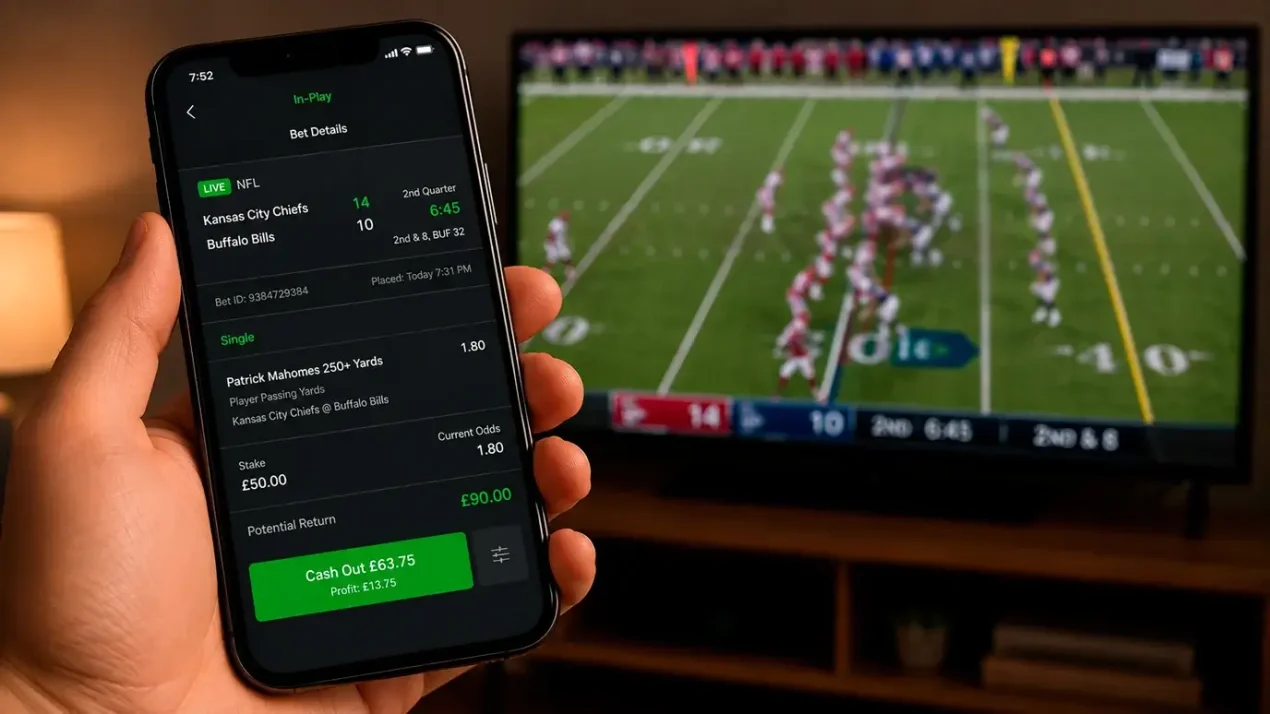
The four-leg ticket I cashed for half what it was worth
Late one season I had a four-leg accumulator running at £180 to return roughly £1,400. The fourth leg was a heavy favourite who needed a single touchdown to land. With ten minutes left in the third quarter, the bookmaker offered me £760 to cash out. I took it. The favourite scored twice in the fourth quarter and the full bet would have paid out in full. I made a profit. I also made a mistake, and the mistake was the more interesting outcome than the money.
I had not done the math. I had taken the cash-out offer because the number looked big relative to my stake, not because the offer was actually fair value relative to the probability of the remaining leg. Once I sat down and calculated what the bookmaker had paid me – about 55% of the expected value of the full ticket – I understood that cash out is a product with mechanics worth learning. Like all bookmaker products, it is priced to favour the bookmaker. The skill is knowing when the offer is worse than the bookmaker’s typical edge and when it is, occasionally, better.
The mechanics of how cash out is priced
A cash-out offer is the bookmaker’s calculated estimate of the current value of your bet, minus a margin. The calculation runs continuously: as the game state changes, the bookmaker reprices the probability of your selections landing, multiplies by your potential payout, subtracts a margin, and presents the result. The margin is usually 5% to 15% of the calculated fair value, depending on the operator and the specific bet.
For a single-leg bet, the cash-out offer is roughly the in-play price on your selection multiplied by your stake, minus the bookmaker’s margin. For an accumulator, the calculation compounds. If three legs of a four-leg parlay have already settled, the cash-out offer is based on the in-play price of the remaining leg multiplied by the parlay’s accumulated value, minus margin. The compounding is what makes accumulator cash-out offers look generous in absolute terms – the parlay multiplier has already done most of the work before the final leg is even decided.
The bookmaker’s margin on cash out is generally higher than the bookmaker’s margin on the original bet you placed. The reasoning is that cash out is a convenience product. You are paying for the option to exit. The question is whether the convenience is worth the margin you are paying. Sometimes it is. Often it is not.
Calculating expected value before you press the button
The math you need is simple in principle. Estimate the probability of your remaining selection landing. Multiply that probability by the full payout you would receive if it lands. That is the expected value of holding the bet. Compare it to the cash-out offer. If the cash-out is higher than the expected value, take it. If lower, hold.
To make this concrete: I have a single bet on a player anytime TD at +150 for £50, projecting £125 in winnings if it cashes. The bookmaker offers me £35 to cash out mid-game. The implied probability of the original price was 40%. If I now estimate the in-game probability of the TD at 30% (the player has not scored and there are 8 minutes left), my expected value of holding is 30% multiplied by £125, which is £37.50. The cash-out offer of £35 is below my estimated expected value. I hold.
The same math runs on accumulators, just with more layers. The trick is being honest about your in-game probability estimate. The temptation is to be optimistic – to believe the leg will land because you want it to. The cash-out offer, in those moments, is the bookmaker’s more honest estimate of probability. If the offer is meaningfully below my estimate, it is worth asking whether my estimate is biased.
The partial cash-out option and when it actually helps
Most major UK operators now offer partial cash out, which lets you cash out a portion of your bet while leaving the rest active. The math is the same as full cash out, scaled to whatever percentage you choose. The intuition is that you can lock in some profit and let the rest ride.
Partial cash out genuinely helps in one specific scenario: when the bookmaker’s offer is below your estimated fair value, but the variance of the remaining outcome is too high for you to comfortably hold the full position. Cashing out 50% protects against the worst-case outcome while leaving meaningful upside if the bet lands. This is a risk-management tool, not an expected-value optimisation. You are giving up some EV for reduced variance, and whether the trade is worth it depends on bankroll considerations and personal comfort.
Where partial cash out does not help is when the offer is bad value. A bad offer at 100% is still a bad offer at 50%. The fractional structure does not change the math – taking half a bad deal is half a bad deal. The genuine use case is variance management, not EV improvement, and being clear-eyed about which one you are doing is what keeps the partial cash-out button from becoming a comfort blanket that costs money over time.
When in the game the offer is structurally best
The cash-out offer is most generous, relative to the underlying probability, during the period of highest in-game uncertainty. For an NFL game, that is typically the second quarter and most of the third. Early-game offers reflect a probability that has barely diverged from the pre-game line – there is little for the bookmaker to add or subtract. Late-game offers reflect a probability that has converged toward 0% or 100% – the variance is gone, and the offer simply reflects the near-certain outcome minus a small margin.
The sweet spot is mid-game, when the score and the time remaining create meaningful uncertainty and the bookmaker’s pricing engine has to estimate. That is when the offers are most prone to mispricing, in either direction. I have taken excellent cash-out offers in the third quarter when the bookmaker over-weighted a recent scoring run and offered me a number that exceeded my estimate of the bet’s value. I have refused poor offers in the same window when the engine under-weighted my selection’s remaining path.
Live football is the UK’s largest live sports betting segment – about 6% of all UK adults bet on it in the most recent quarterly survey – and the in-play infrastructure those operators have built for football carries over to NFL. The pricing engines on UK books are generally sharp during the live window. Soft cash-out numbers exist, but they are not the default. Treating cash out as a tool to deploy occasionally, rather than as a default exit ramp, is the discipline that separates profitable use from value leakage.
Cash out on SGPs and accumulators
Multi-leg bets present the trickiest cash-out math. For a parlay where some legs have settled and others remain live, the cash-out value depends on the in-play probability of the remaining legs, the accumulated multiplier from the settled legs, and the bookmaker’s margin. The compounding makes the offer numbers visually striking, which is part of why cash out gets used heavily on accumulators.
The same principle applies. Calculate the expected value of holding – probability of each remaining leg landing, multiplied through, multiplied by potential payout. Compare to the offer. UK operators have invested significantly in withdrawal infrastructure, with data showing the largest gambling companies process around 99% of customer withdrawal requests within 24 to 48 hours of the request being made. That is real consumer-protection infrastructure, and it makes the cash-out decision purely an EV question rather than a logistical one – once you cash out, you have the money quickly.
The one structural twist on SGPs is that not all UK operators allow cash out on every SGP construction. Some books exclude same-game parlays from cash out entirely. Others allow it but with steeper margins than on cross-game accumulators. The smaller the operator, the more restrictive the cash-out rules tend to be. If cash-out flexibility matters to your betting style, it is worth checking the small print before depositing – different operators have meaningfully different policies.
What I actually do with the cash-out option
The honest summary of how I use cash out: rarely, and only when the math is clear. For straight bets, I almost never cash out – the bookmaker’s margin is generally higher on the cash-out offer than on the original bet, so unless the in-game state has shifted dramatically against me, holding is the right call. For accumulators with one or two legs remaining, I will occasionally cash out if the math shows the offer is above my estimated expected value or if the variance of the remaining legs is uncomfortably high relative to my bankroll position.
The button itself is designed to be tempting. The number is large, the moment is emotional, the game is happening live. The discipline is to do the math before pressing it – and to remember that the bookmaker is offering you the cash-out because they expect to win on average across all the offers they make. Beating the average requires being right about when the offer is generous and when it is not. Most punters press the button without doing the work. That is exactly the behaviour the product is designed to reward.
At what point in an NFL game does cash-out typically offer the smallest house edge?
The mid-game window, roughly the second quarter through most of the third, is generally where the offers carry the smallest margin relative to the underlying probability. Early-game offers carry meaningful margin because the pre-game variance is still mostly intact. Late-game offers carry small margin in absolute terms but the probabilities have already converged toward certain outcomes, so the offer reflects near-final state minus a small fee. The middle window is where the bookmaker’s pricing engine has the most work to do, which is where occasional mispricing emerges.
Can I cash out an NFL Same Game Parlay if one leg has already settled?
It depends on the operator. Some UK bookmakers allow partial cash out on SGPs once individual legs have settled, with the offer recalculated to reflect the remaining live legs. Others exclude SGPs from cash out entirely, treating them as a single combined product that resolves only at full settlement. The third group allows cash out on SGPs but at noticeably steeper margins than on regular accumulators. Checking each operator’s specific cash-out policy on SGPs before placing the bet is the only way to know what you are working with.
If holding a bet to settlement is something you would rather avoid in favour of longer-horizon plays, the natural pivot is into the futures-market side of NFL betting – where the question of when to exit a position looks structurally different.
This material was created by the YardLedger team.
Related posts

Passing Yards Prop Strategy for NFL: Reading Lines, Pace and Defensive Context

NFL RB Committee Prop Strategy: How to Bet Backfields That Refuse to Anoint a Workhorse