NFL London Games Player Props: Wembley and Tottenham Lines
 Available in US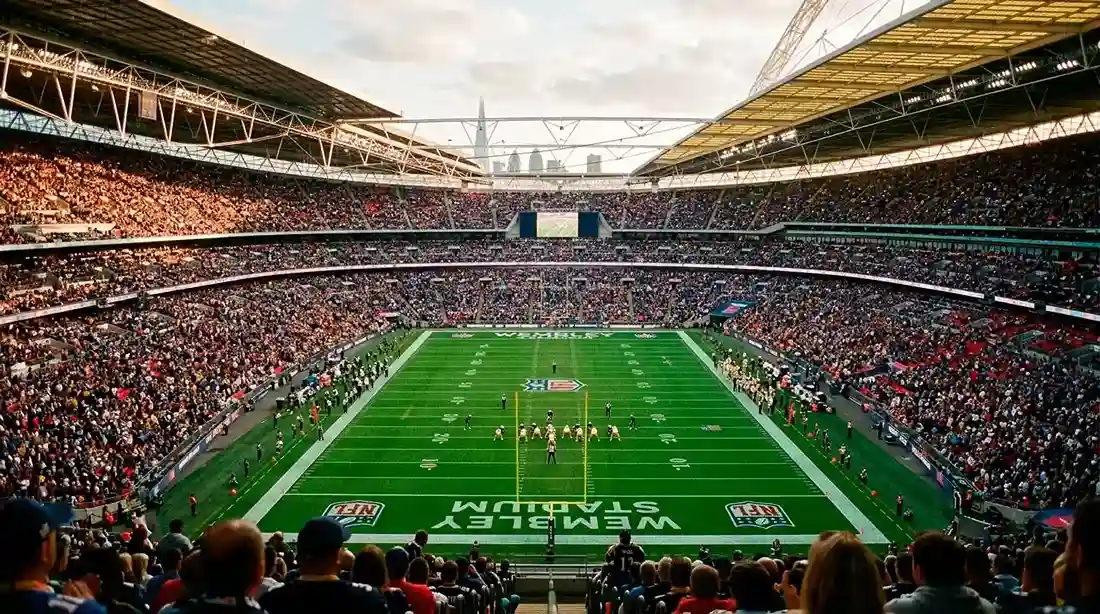
Early Kick-Off Impact on NFL London Betting Markets
The first time I bet a London Game seriously was a Rams-Jaguars fixture at Wembley, sat in the upper bowl with a phone open on bet365 and a notebook on my knee. Kick-off was 14:30 BST. By 14:35 I had a passing-yards under that was already winning me money because the visiting quarterback hadn’t completed a pass yet. That’s the moment the penny dropped: a London Game isn’t just a regular NFL Sunday with a worse postcode. It’s a six-hour betting window that compresses everything you’d normally spread across a full slate.
Wembley sold 86,152 tickets for that single Rams-Jaguars fixture, and the noise that produced told me something the spreadsheet had only hinted at: the London product is a different beast for prop bettors. Over the next eighteen months I’ve adjusted nearly every part of how I approach these games — when I bet, what I bet, which side of the line I lean — and almost all of it traces back to one structural fact. The market gets one bite at this. Open Sunday morning, settle Sunday evening, and most of the British staking activity hits inside the same six-hour block.
This is the piece I wish I’d had in front of me before that Wembley afternoon. It’s not a tip sheet. It’s a working guide to how I read player props specifically for the London slate, why the lines look the way they do, and where I think edge actually lives versus where the marketing makes it look like it lives.
How much the London staking column has actually grown
Here’s a number that stopped me when I first saw it: total staking on the 2024 London Games was 51% higher than on the equivalent 2023 fixtures. Not 5%, not 15% — fifty-one. That doesn’t happen by accident, and it doesn’t happen because the casual market has suddenly learnt what a play-action fake is. It happens because the infrastructure around these games — the tickets, the broadcasts, the build-up — has matured into something British punters now treat as a calendar event in its own right.
The longer-arc figures put the 2024 jump in context. The three-millionth fan walked through a turnstile at a London Game in 2024, which means the city has hosted roughly nineteen seasons of fixtures and absorbed enough collective experience that we now have a meaningful sample of how these games behave. Each fixture is estimated to feed about £6.1 million into London’s economy through tourism, hospitality and local spend, and that scale of commercial activity isn’t divorced from the sportsbooks — it’s the same audience, the same Sunday, the same enthusiasm pointed at a different vertical.
For me, the staking number translates to two practical things on the trading screen. First, lines move faster on London weeks because there’s more money chasing them. A Friday opener that I’d normally have until Saturday lunchtime to digest can shift two or three yards on a popular receiver within hours of release. Second, the public side gets bid into more aggressively. If a fixture has a high-profile quarterback playing his only UK appearance of the season, his passing-yards over will absorb a disproportionate share of recreational money, and that creates the kind of softness on the under that I want to be on the right side of.
It’s also worth noting how much of the audience is global rather than purely British. Seat Unique’s NFL content has pulled visitors from more than 180 countries since the start of 2025, with over 40% of traffic to its NFL pages arriving from outside the UK. The reason that matters for prop bettors is that London Games are no longer priced as a UK-only product. The same lines I’m shopping are being shopped from Frankfurt, Madrid, and Dublin, and the sharper offshore action gets baked in before British recreational money even logs on.
The 2026 London schedule and what the prop boards will look like
2026 is the season I’ve been waiting on for a while, and not just because it’s the run-up to the twentieth anniversary of London Games in 2027. The NFL is putting nine regular-season fixtures abroad next season — the most ever — with three of them landing in London. The other six are split between Dublin, Berlin, Madrid, and brand-new debuts in Melbourne, Rio de Janeiro, and Paris. That’s a step-change in the size of the international slate.
For prop boards specifically, what this means is more lead time and more comparative data. When London was hosting three games in a season but the rest of the international schedule was thin, every fixture was treated by the books as a near-bespoke event. Now the international slate is large enough that prop modellers can lean on a growing reference set of jet-lagged offences, time-zone-skewed defences, and turf-versus-grass surface splits at venues that don’t host weekly NFL action.
The three London fixtures themselves will follow the pattern I’ve come to expect. Two at Tottenham Hotspur Stadium, one at Wembley, all in the September-October window before the NFL bye-week structure kicks in. Player prop trees will go up at most UK books on the Tuesday or Wednesday of game week, with the deepest selections appearing by Friday morning. If you’re hunting value, the gap between the Tuesday board and the Saturday board on a London fixture is usually where I find the largest mispricings — opening lines tend to be conservative, and the recreational money that pushes them rarely arrives before Saturday evening.
One quirk to flag. London fixtures often draw teams that are not picture-perfect playoff contenders. The visiting side is frequently a club building international fanbase under the league’s marketing programme, which means the rosters can include a star player whose performance pattern is well-documented and a supporting cast whose road splits aren’t. That asymmetry is where I’d encourage anyone newer to the slate to focus their reading — the headline player’s line will be efficient; the WR3 receiving line might not be.
Wembley and Tottenham draw very different rooms
If you’ve only ever been to one London Game, it’s easy to assume the two venues are interchangeable. They are not, and the difference shows up in the betting markets if you look closely enough.
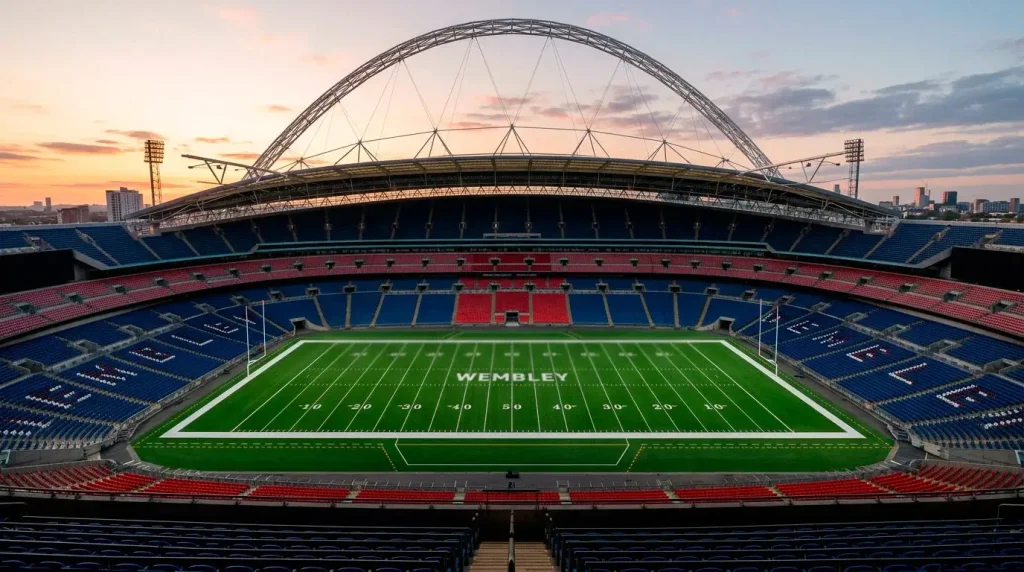
Wembley seats 86,000-plus, which is roughly 26,000 more bums on seats than Tottenham. That capacity gap matters because it shapes the audience profile. A Wembley fixture absorbs more casual ticket-buyers — first-time attendees, corporate groups, families who fancied a day out — and the betting handle that follows tends to skew towards the obvious markets. Star quarterback anytime touchdown scorer at 5/1. Star running back over the headline rushing-yards line. Match winner on the favourite. These are the props that get hammered, and the books price them accordingly. By Sunday morning, the juice on those popular sides has often inflated to the point where the genuine edge sits on the contrarian leg.
Tottenham at 62,000 capacity is a different room. The Spurs stadium hosts more of what I’d call hardcore NFL fans — season-ticket holders for the UK programme, fans who fly in from Europe specifically for the fixture, people who track snap counts on a Wednesday evening. The recreational layer is thinner. As a result, the markets there feel a touch less skewed towards the chalk. Props on second-tier receivers and committee backs tend to be priced more accurately at Tottenham than at Wembley, in my experience. The flip side is that the genuine soft spots at Wembley — the recreational-money inflation — don’t really exist at Spurs.
Practically, what this means for how I bet: at a Wembley fixture I’ll happily play the under on a headline player’s yardage line if the market has run it up two or three yards above the consensus, because I know recreational money is doing the running. At Tottenham, that same line tends to be sharper from the off, and I’ll look for edge elsewhere — usually in receiving-yards markets on the second-target receiver, where the casual layer never quite shows up.
Henry Hodgson, who runs the NFL’s UK and Ireland operation, put the maturity of the London market well when he noted that the league is now heading into games 37, 38, and 39 in a relationship that began in 2007. “We are a mature market, that’s exciting,” he said, “but for a lot of the fans that are coming to the stadium, regardless of whether it’s game 37 for us, it might be game number one for them.” That tension — institutional maturity layered on top of perpetually arriving newcomers — is exactly what the prop board reflects every London Sunday.
The prop types that actually move money on a London Sunday
Ask a casual punter to name an NFL prop and they’ll say anytime touchdown scorer. Ask them which prop type they actually back on a London Sunday and the answer is the same. Anytime TD scorer is, by some distance, the most-staked single player prop on UK books for London fixtures, and the reason is structural: the payout shape suits casual money. A 4/1 ticket on a high-profile name feels like a gettable result and pays enough to be worth the screenshot if it lands.
That’s the market the public lives in. Where I tend to spend most of my time on a London Sunday is one layer down.
Passing yards under for the visiting quarterback
This is the position I come back to season after season. Typical passing-yards lines for a starting NFL quarterback sit in the 250-300 yard range during the regular season, and London fixtures rarely deviate from that band. The under bites more often than the market prices because of factors I’ll get to in the jet-lag section — early kick-off relative to the visiting team’s body clock, an unfamiliar pre-game routine, a stadium that doesn’t follow the home rhythms the quarterback has trained for. When two top-ten teams by pace of play face each other you’d expect roughly 10% more offensive plays than the league average, which pushes overs in normal venues. London inverts that for the visiting side often enough that the under is a position I actively look to take.
Anytime TD on a slot receiver, not the WR1
The headline wideout will be priced sharply on every London board because that’s where casual money lands. The interior receivers — slot WRs, third-down specialists, red-zone target hogs — tend to carry the cleaner numbers. Red-zone target share is the data point I’d keep close. A slot receiver with a 20%-plus red-zone target share through the season-to-date but priced at 5/2 or 3/1 anytime TD is the kind of ticket I’ll fire on most London weeks.
Receiving yards in the 3.5-7.5 reception band for starting wideouts
This is the bread-and-butter prop bookmakers make a living on. Reception props for starting WRs in the UK market commonly sit between 3.5 and 7.5, with the most-staked options clustering around 4.5 and 5.5. For London fixtures, the reception under on the second wideout — the WR2 rather than WR1 — has historically been a position with reasonable edge, because the public assumes both starters will share the load when in practice the quarterback’s preferred read in an unfamiliar stadium is almost always WR1.
Rushing yards under in early-kick fixtures
Running backs are the position whose body clock seems least affected by travel, but the surrounding context — quarterback rhythm, offensive line cohesion, defensive front comfort — still moves the rushing line. A passing-game under often pulls a rushing-game over with it. Game script matters here: if you expect the visitor to be chasing, that’s where rushing-yards unders for the visitor’s lead back become live.
First-half over/under markets
This is the prop I lean on most heavily in the live window. The first half of a London Game is where the body-clock disadvantage shows up most clearly, and first-half scoring totals or first-half passing-yards markets tend to settle below their pre-game pricing in a meaningful share of London fixtures. The live market reads the slow start as a temporary blip and prices the second half aggressively — that’s the moment to consider a first-half under or a half-time scoring lead change.
The jet-lag question, and what the data really says
The jet-lag thesis is the single most-discussed angle in any pre-London-Game piece, which is exactly why I want to be careful with it. The temptation is to treat it as a magic key — back every visiting team’s offensive prop under at 14:30 BST and retire to the Algarve. That’s not how it works. But there is a real edge here if you respect the texture of the data.
Start with the maths of the body clock. A team flying from the US East Coast lands roughly five hours behind UK local time. A team flying from the Pacific Coast is eight hours behind. Kick-off at 14:30 BST is, for a West Coast visitor, the equivalent of an 06:30 alarm-call kick-off — and not the comfortable late-morning kick of a 16:25 ET home game. Cognitive performance, fine-motor coordination, and reaction time all measurably degrade in the first hours after waking. None of these things are catastrophic individually. Stack them across an offence that depends on quarterback timing and receiver-route concentration and they start to add up.
The market does try to price this in. Opening lines for visiting quarterbacks at London fixtures are usually a yard or two below their season-to-date averages, and team total points are similarly shaded. The question is whether the shading is sufficient. My honest read across the fixtures I’ve tracked is that it isn’t — the public bet on the over too consistently in the lead-up, and lines that should drift down often drift up by Saturday evening. That gap is where I think real edge has historically lived.
Some caveats worth keeping. East Coast visitors (especially teams based in the Eastern time zone) seem far less affected than West Coast visitors. Teams that fly out on the Thursday and use a fully London-based pre-game routine fare better than teams arriving Friday or Saturday. And the public mood swings hard after the first half. If the visitor starts well, the live market over-corrects towards overs for the rest of the day — a tradable mistake if you’re patient.
None of this is a magic key. It’s a tilt, and the tilt is worth maybe a yard or two on the headline yardage props if you back it consistently. That sounds small. Stack it across a season and it’s the difference between a flat profit-and-loss curve and a slightly upward-sloping one.
What the NFL itself is signalling about London as a hub
The league’s own posture on London matters because it tells you something about how much weight the market will continue to place on these fixtures. Henry Hodgson, the NFL’s General Manager for UK and Ireland, has been consistent on this point across the last two seasons. “The NFL obviously has a very clear priority around growing the game globally,” he said in early 2026, “but London’s really been at the centre of that for the longest time.”
That isn’t marketing fluff dressed up for a press release. It’s a statement about commercial intent, and commercial intent translates to schedule. The 2026 nine-game international slate, three London fixtures, the 2027 twentieth-anniversary season — these aren’t accidents. The league is using London as a proof-of-concept for a global product, which means the broadcast investment, the marketing spend, and crucially the playing standard of the visiting clubs are all being protected. London Games no longer get fobbed off with two also-rans. They are increasingly matchups the league wants showcased.
For prop bettors, what this signals practically is that the betting market for London fixtures will continue to deepen. More prop markets will open earlier. More books will offer match-specific Bet Builder structures. More research material will be in public circulation by Saturday morning. All of which means the soft spots I’ve described above will get harder to find as the seasons go on. The window is still open — but the older you let your London playbook get, the less the playbook will work.
When the markets open and how the boards drift before kick-off
Most UK books open match-winner and basic player markets for a London fixture on the Tuesday or Wednesday of game week. The full prop tree — the long-tail markets, the Bet Builder selections, the alternate yardage lines — typically lands by Wednesday evening or Thursday morning. By Friday, opening boards are mostly stable; by Saturday, the recreational layer of money has begun to arrive.
This sequence creates a predictable rhythm. Tuesday and Wednesday lines are sharpest in absolute terms but often poorest in selection — half the markets you’d want aren’t open yet. Thursday and Friday morning are the window where I’m doing most of my pre-game work, because the tree is up but the recreational money hasn’t yet bid up the popular sides. Saturday afternoon onwards is when public-side pricing inflates and the contrarian unders start to look attractive. Sunday morning, two to three hours before kick-off, is the moment for last-minute injury-report reactions — the inactives list typically drops 90 minutes before kick-off, and any meaningful absence can move a related prop by 10-15% in seconds.
One detail specific to London Games. Because kick-off is 14:30 BST — a window that overlaps with the morning newspaper trading session for the books — the line movement on a London fixture between 11:00 BST and 13:30 BST is often the heaviest of the week. Books will reprice aggressively into the kick-off, partly because volume is heavier and partly because their US-based liability is still active. If you’ve been sitting on a position, that’s the window where it’s most likely to drift away from you. I usually settle my pre-game tickets by Saturday night for that reason.
The other London-specific quirk is the live window itself. NFL broadcast partners now show London Games to a UK audience that has grown alongside the 2025 season’s 32% rise in NFL Network international games viewership. More eyes on the broadcast means more money on the live markets, which means thinner spreads but also faster repricing. The cash-out values in the second quarter of a London Game move faster than I see on the equivalent regular-season Sunday-night fixture, and that’s worth knowing if you’re holding a winning pre-game ticket and tempted to lock it in early.
Why do NFL London Games attract heavier player prop staking than US-based fixtures?
London Games concentrate the UK betting audience into a single afternoon window with high-profile broadcast support, novelty-of-attendance enthusiasm, and a calendar slot where the rest of the NFL slate hasn’t kicked off yet. Entain reported staking on 2024 London Games up 51% on the equivalent 2023 fixtures, which is the kind of move that doesn’t happen for ordinary US-based weeks. The audience is also wider than the regular weekly base — more casual punters in the room, more share of mind across the British sporting press.
Which positions tend to underperform in early-kick London games due to travel?
Visiting quarterbacks, especially those flying from the Pacific time zone, tend to underperform their season-to-date passing-yards averages in the first half of London fixtures. Receiving production for the visiting team’s WR2 and WR3 also frequently lags pre-game pricing because the quarterback gravitates to his preferred read in an unfamiliar stadium. Rushing back production is the least affected — the position depends less on quarterback timing and more on individual physicality.
Can I bet on player props for London Games before the rosters are officially confirmed?
Yes. UK books post the bulk of their London Game prop tree by mid-week, well before the official inactives list drops on Sunday morning. If a player is then ruled out, the relevant prop is typically voided rather than settled as a loss. Rules vary by operator on what counts as ‘not playing’ — most accept inactive status, but late in-game scratches after at least one snap will usually still settle as written.
What I keep on my London weekend checklist
A London Game week is the closest thing the NFL season offers to a betting set-piece, and the way I approach it has crystallised over years of getting the same things right and the same things wrong. The big themes worth carrying forward: open prop trees by mid-week and use the gap to Friday for your real research; respect the jet-lag tilt without treating it as a magic formula; look one layer below the headline quarterback for the props where genuine edge has historically sat; and remember that the staking-growth trend means the soft spots are shrinking each year.
For the deeper question of how injury news and roster confirmations move these specific markets in the days before kick-off, the timing of when London Game prop markets open is worth a separate read.
This material was created by the YardLedger team.
Related posts

Passing Yards Prop Strategy for NFL: Reading Lines, Pace and Defensive Context

NFL RB Committee Prop Strategy: How to Bet Backfields That Refuse to Anoint a Workhorse