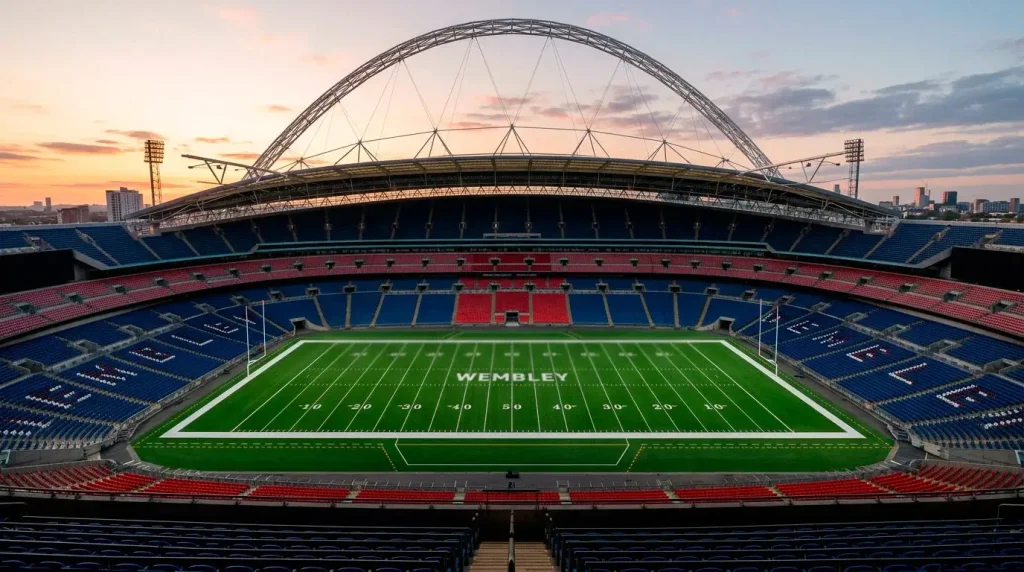
NFL London Game Props and Roster Line Moves
 Available in US
Opening Line Timing for NFL London Prop Markets
A few years back I missed a soft opening line on a London Game tight end by about ninety minutes. Bookmaker posted at roughly nine in the morning, I logged on at eleven, and the line had already moved three points. Cost me nothing – I did not place the bet – but it taught me something I should have known: the prop market for London fixtures is a different timing animal than a Sunday slate in October. When 2026 brings three London Games as part of a record-breaking nine international fixtures, that timing question is going to matter more, not less.
What follows is what I have pieced together about when UK books open their NFL London prop trees, how roster news reshapes those trees, and where the predictable line movement actually lives. None of this is rocket science. But the people who get the best of London Game prices are the ones who treat the early week like a working schedule rather than a passive scroll.
The opening clock for a Sunday London fixture
UK bookmakers do not all open at the same time, but the rough hierarchy I have watched is consistent. The biggest operators post their primary player prop trees – passing yards, rushing yards, receiving yards, anytime touchdown scorer – on the Tuesday morning before kick-off, usually between 09:00 and 11:00 BST. Smaller books follow Tuesday afternoon or Wednesday morning. By Wednesday evening, every UK-licensed operator with a meaningful NFL offering has its props on the board.
The opening lines on Tuesday are the most informationally clean. Books are pricing off projection models, depth charts and prior-week performance, with limited input from this week’s practice signals. That is where you get the genuine inefficiencies – the lines that move two or three yards once Wednesday’s practice report drops. The trade-off is that limits are tighter on Tuesday than they are Saturday. Books will not let you fire £500 into a stale line at the open. They will let you nibble at £20 to £50, and that is often plenty.
Wednesday and Thursday are when the tree fills out. Same-game-parlay markets, specials, exotic combinations – all of that arrives after the primary lines have absorbed initial action. By the time a London Game tips off at 14:30 BST on Sunday, a mature prop tree at a top-five UK book runs to three or four hundred markets per fixture.
Why injury news hits harder for London than for a domestic slate
Injury reports for London Games have one structural quirk: the league requires teams to file the standard Wednesday-Thursday-Friday practice reports just as they would for a Sunday game at home, but the actual practice for an international fixture is often happening in suburban London under different conditions than the team’s normal facility. That changes how the practice designation should be read.
What I look for is the gap between a player’s listing and what makes physical sense given the travel. A “limited” practice on Friday in London for a defensive end with a calf strain who flew Thursday is operationally different from a “limited” practice for the same player in Florham Park before a home game. The former is a heavier load, in a less controlled environment, with worse sleep underneath it. UK bookmakers know this. The smart prop traders adjust their pricing accordingly, and that is where you see Friday and Saturday line moves that look bigger than the listed-status change would imply.
The other thing London Games do is concentrate the betting public’s attention. Roughly 1.2 million UK searches per month are NFL-related, and more than 40% of NFL traffic at major UK content sites comes from outside the country during international weeks. That broader audience means bookmakers see heavier action on London Game lines than on a comparable domestic Sunday fixture, which compresses the closing-line value but widens the early-week opportunity. The earlier you commit, the less competition you have for the soft number.
Inactives and the 90-minute window before kick-off
The NFL releases its official inactives list 90 minutes before kick-off. For a 14:30 BST London Game, that means 13:00 BST on Sunday. This is the most chaotic window of the entire prop week, and it is the one where most casual punters lose money.
Here is what happens. A team announces that its starting wide receiver is inactive after being listed as questionable. Most UK books will suspend the related prop markets – anytime TD on that receiver, receiving yards, receptions – within seconds. They will then either void existing bets, depending on bookmaker rules, or reprice the alternate players on the depth chart. Reprice usually takes between two and ten minutes. During those minutes, secondary receivers on the same team frequently have their lines move by 8 to 15 yards on receiving totals, and their anytime TD prices can shorten dramatically.
The window for capturing value off a late scratch is small but real. If you have already done the work – you know who the next man up is, what their share would be, and where the line should land – you can place a bet inside the first 60 seconds after the inactives drop and beat the bookmaker’s reprice. I will not pretend this is a relaxing way to bet. It is not. But for the disciplined, it is one of the cleaner edges available in the London prop market.
The practice report as a leading indicator
Practice reports are not just a list of who is hurt. Read carefully, they are a leading indicator of game-plan intent. A starting tight end who has been a full participant all season suddenly limited on Wednesday with a “rest” designation is telling you something about workload management. A backup running back getting a “did not participate” with no listed injury is sometimes a tell about role shifting.
For London Games the practice report carries an extra layer because the team is also adjusting to environment. A player who showed up on the Thursday report with an illness designation, in my experience, is more likely to be downgraded by Saturday than one with a soft-tissue injury. Travel suppresses the immune system. I have watched bookmakers reprice receiver props on Thursday-flu listings more aggressively than on equivalent muscle-strain listings, and the reasoning is sound. The “questionable” tag means roughly 70% likely to play, but the path to that 30% non-play is different depending on what is wrong.
What I do with practice reports: I read them, but I do not react until I have seen Friday’s update. The Wednesday report is the team announcing what it would like to do. The Friday report is the team telling you what it can do. If a status has held through Thursday and Friday at the same level, the implied probability of play is much higher than the listed designation alone would suggest.
What changes when the schedule expands
The 2026 international slate is genuinely different. Three London fixtures, plus games in Dublin, Berlin, Madrid, Melbourne, Rio de Janeiro and Paris – nine international games total, up from seven in 2025. That growth changes the prop market in two ways that UK punters need to think about.
First, attention is going to be spread across more international fixtures rather than concentrated on a handful. London Games will still be the headline event for UK audiences, but a Berlin or Madrid fixture for a UK punter is functionally a London Game for a German or Spanish punter – same timing window, same early-kick body-clock dynamics, same heavier roster news scrutiny. The patterns I have described above are going to start showing up in lines for the non-London international games too, and the books are still figuring out how to price them. That is genuine inefficiency, available to anyone willing to do the work.
Second, the volume of international betting handle means the UK market will increasingly behave like a hybrid – domestic in regulation but international in attention. That has implications for limits, for promotional pricing and for how quickly soft lines disappear. I have already seen 2025 London Game opening lines tightening faster than 2023 lines did. The opportunity is still there. It is just narrower.
How many days before a London Game do UK bookmakers post player prop trees?
The primary props – passing yards, rushing yards, receiving yards, anytime TD scorer – typically post on the Tuesday morning before kick-off, between 09:00 and 11:00 BST at the biggest UK operators. Smaller books follow on Tuesday afternoon or Wednesday morning. The full mature prop tree, including same-game-parlay markets and exotics, is generally complete by Wednesday evening, giving you four to five days of pre-kick action.
What’s the practical difference between an NFL ‘questionable’ and ‘doubtful’ tag for prop bettors?
‘Questionable’ implies roughly a 70% chance the player suits up, and the prop markets usually stay open with adjusted limits. ‘Doubtful’ implies about 25% – most UK books will leave related props open but at materially shortened or suspended pricing, and many will void single-leg bets if the player is downgraded to out. For practical purposes I treat ‘questionable’ as a live betting market and ‘doubtful’ as a market I avoid unless I have a strong independent read on the player’s status.
The natural next step from here is understanding how NFL injury report codes actually translate to snap counts and prop performance across the full season – because the timing question is downstream of how you read the status tags themselves.
This material was created by the YardLedger team.
Related posts

Passing Yards Prop Strategy for NFL: Reading Lines, Pace and Defensive Context

NFL RB Committee Prop Strategy: How to Bet Backfields That Refuse to Anoint a Workhorse