Compare UK and US NFL Sportsbooks and Props
 Available in US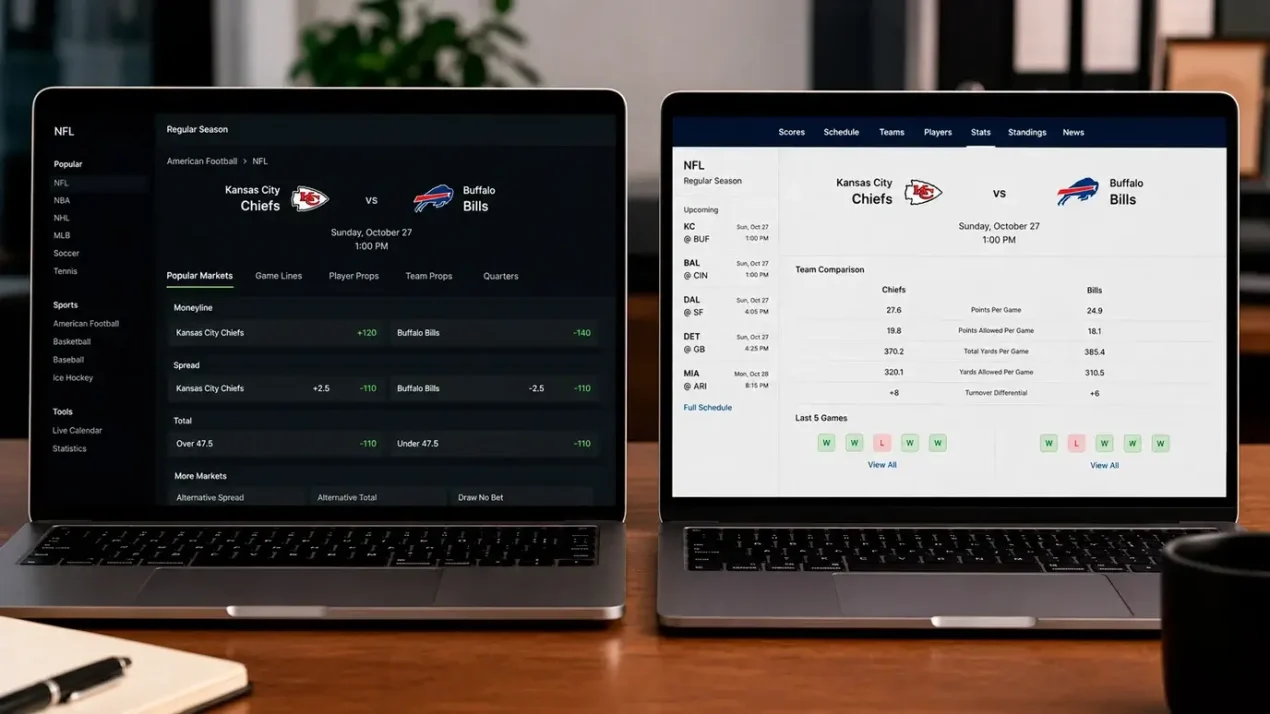
NFL Prop Market Discrepancies Between UK and US Books
The first time I logged into a US sportsbook from a hotel in New York, the NFL prop tree on a single quarterback ran to over a hundred markets – alternate passing yards in two-yard increments, first-half passing yards, longest completion, completions over/under, passes attempted, sacks taken, every variant you can imagine. On the UK book I was paying attention to that same morning, the same QB had fourteen markets. The fundamental product looked similar but the depth was a different category of thing. That experience reshaped what I expect from a UK book and how I evaluate when crossing over to a US product would actually help me, versus when it would just complicate my life.
What follows is the working comparison I have built across both markets. Some of the differences are regulatory. Some are commercial. Together they make UK and US NFL prop markets two distinct ecosystems with different rules, different products and different value pockets.
Licensing is the structural difference that explains most of the rest
The UK Gambling Commission regulates every gambling operator that wants UK customers. There is no state-by-state framework. Operators apply for a UKGC remote licence, comply with the full national rulebook, and serve the entire UK market under one regulatory regime. The trade-off is that UKGC compliance is rigorous and expensive. In the period October 2024 to September 2025 the UKGC issued 806 cease-and-desist letters and saw 314 unregulated sites geo-blocked from UK access. That is not a market with permissive entry. That is a market with controlled entry.
The US framework is the opposite shape. Sports betting is regulated state-by-state, and each state writes its own rules around market depth, advertising, taxation and consumer protections. A sportsbook operating in 25 US states is running 25 parallel compliance regimes. The cost of operating across that fragmentation is significant, but the upside is that a US-licensed sportsbook can be more aggressive in offering markets that UK regulation discourages – exotic props, in-play variants, certain promotion structures.
The practical implication for a UK punter is binary. You cannot legally place an NFL bet at a US sportsbook from the UK, and US sportsbooks will not accept your account. The geo-blocking is technical and consistent. Any service that promises to circumvent it is operating outside the licensed framework, which is a different conversation and one I would not recommend pursuing.
Market depth on the same fixture
The depth difference is the most visible structural divergence. A US sportsbook on a Sunday primetime fixture typically offers 250 to 400 player prop markets per game. A UK book on the same fixture offers 60 to 150. Both numbers move with the fixture’s profile – a Super Bowl explodes both, a Thursday Week 1 game compresses both – but the gap stays consistent.
The depth gap is most visible on alternate lines. US books offer alternate lines on virtually every prop – alternate passing yards every 2 yards, alternate receiving yards every 5 yards, alternate rushing yards every 5 yards. UK books offer alternate lines on the headline props (passing yards, anytime TD) but rarely extend the granularity to secondary props. The implication is that UK punters have less ability to pick a precise number that aligns with their model and instead bet whatever the standard line is, which means accepting some inefficiency in the bet structure.
The depth gap on defensive props is dramatic. Sacks props on individual edge rushers, tackle props on linebackers, interception props on defensive backs – these are routine US markets and patchy UK ones. Some UK operators offer a handful each week, others offer none. A UK punter who wants to play defensive props is dependent on which books happen to post them for which fixtures, which constrains the strategy meaningfully.
Odds format, fractions and the language barrier
The cosmetic difference everyone notices first is odds format. UK books default to fractional odds (5/2, 11/10, 8/13). US books default to American odds (+250, -110, +175). The math is the same – a fraction can be converted to American or to decimal – but the cognitive load is real. A UK punter scrolling a US sportsbook spends an extra moment converting every price. A US punter on a UK book does the same.
The technical conversion is straightforward. Fractional 5/2 equals American +250 equals decimal 3.5 equals implied probability 28.6%. Most punters get comfortable with one format and use a conversion table or a habit-of-thought to translate the others. UK books increasingly offer a decimal-odds toggle, which makes cross-comparison easier. American odds, in my view, are the friendliest format for parlay math – the +/- structure maps cleanly to mental probability.
The deeper question is pricing competitiveness, which is separate from format. A typical UK book on a headline NFL passing-yards prop offers a -110 or -115 vig (in American terms) on each side. A typical US book offers -110 to -120 on the same prop, sometimes wider on lower-volume markets. The vigs are similar – neither market is meaningfully softer or sharper on average. The differences are matchup-specific and operator-specific rather than systematic.
Promotions and bonus structures diverge by regulation
The promotional landscape is one of the more visible regulatory divergences. UK operators must operate under granular opt-in marketing rules – since May 2025, marketing requires explicit consent at both the product level (casino, betting, bingo) and the channel level (SMS, email, push). The result is a UK promotional market that runs in lower volume but higher relevance – fewer unsolicited offers, more targeted ones.
US operators run more aggressive promotional acquisition. Sign-up bonuses with five-figure headline values, free bet credits, deposit matches at multiples of 100% – the kind of acquisition structure that would not clear UK marketing rules. The headline numbers are larger; the wagering requirements are often more demanding. A UK promotion offering £30 in free bets on a £10 stake is structurally similar to a US offer at higher numbers – the value-to-stake ratio is comparable once you adjust for wagering requirements.
The pricing-driven promotional product – price boosts, enhanced odds on specific selections – is healthy in both markets. UK price boosts on NFL props during a heavy week can offer genuine value if you do the math; the same is true of US boosted prices. Where the markets differ is in volume: US books push more boosts more often, UK books push them more selectively. UK promotional emails have noticeably reduced in frequency since May 2025 due to the opt-in change, which means UK punters who do receive promotions tend to receive ones they actually selected into.
Which segments of the market are softer where
The most useful question for a working bettor is not “which market is bigger” but “where is each market structurally softer”. UK NFL markets are softer on niche defensive props when they exist – books offer them inconsistently and the pricing is less honed than on the headline lines. UK NFL markets are softer on backup-player props following injury news, because the lag from status confirmation to line reprice is longer at smaller UK operators. UK markets are also softer on cross-team SGPs that involve correlated game-flow legs, because the SGP pricing engines at UK books are less sophisticated than the US equivalents on average.
US NFL markets are softer on weeks where state-specific tax adjustments or promotional pushes distort pricing. They are softer on alternate lines, paradoxically, because the depth of the alternate-line tree creates pricing gaps that no engine can patrol perfectly. They are tighter than UK books on headline props in primetime games where US sharp money is heaviest. The UK market remote casino, betting and bingo segment reached £7.8 billion in gross gambling yield over the year ending March 2025 – a serious commercial scale that supports investment in pricing infrastructure, even if it does not match the US in absolute size.
The synthesis I have landed on: UK NFL props are a viable, well-priced market for the type of bettor who works the corners of the lines and accepts that the depth is lower. The market is honest. The compliance is genuine. The bigger US market is structurally different rather than universally better, and for a UK punter operating legally, that comparison is mostly academic.
What the differences mean for a UK punter’s strategy
The strategy implications come down to a few principles. Work the prop types where UK books are competitive – passing yards, receiving yards, anytime TD scorer, rushing yards on lead backs. Avoid expecting depth that the UK market does not offer, like granular defensive props or alternate lines on secondary players. Line shop within the UK market across multiple operators, because the variance between UK books on the same prop is meaningful even if it is narrower than the variance between a UK and US book on the same prop.
The regulatory dimension is unambiguously good for the UK punter from a consumer-protection angle. Withdrawal speeds are fast, dispute mechanisms exist, and the licensing framework is consistently enforced. The trade-off is product depth. Whether that trade-off feels worthwhile is a personal call, but it is one made on a structural basis, not a quality basis. Odds Shark’s Nick Holz, working US markets, framed his championship analysis around a structural data point: “My favourite Super Bowl 60 betting nugget is that the top team by defensive and total team DVOA has advanced to the Super Bowl four times in the last 40 years.” That kind of structural thinking is exactly what works on UK markets too, because both ecosystems reward identifying the durable patterns regardless of which surface-level products are available.
Why can’t I open a DraftKings account from the UK?
DraftKings holds no UK Gambling Commission licence and is therefore not legally permitted to take wagers from UK residents. The platform uses geo-blocking technology to prevent UK-based logins and account creation. The same applies to FanDuel, BetMGM and other US-licensed sportsbooks. The only legal route to NFL betting from the UK is through a UKGC-licensed operator, and the UK market has enough licensed coverage to serve a serious prop bettor’s needs.
Are NFL player prop lines systematically softer at UK bookmakers compared to US ones?
Not systematically. The vigs and pricing on headline props (passing yards, anytime TD, receiving yards) are broadly similar across the two markets – the typical UK and US prop carries a -110 to -120 American-equivalent vig per side. The structural difference is depth: US books offer many more alternate lines, exotic variants and defensive markets. UK markets are softer at the corners – niche defensive props when posted, backup-player lines following injury news, cross-team correlated SGP constructions – rather than across the board.
If the price-finding side of the equation interests you, the next layer is the practical question of when NFL price boosts at UK bookmakers actually represent genuine value.
This material was created by the YardLedger team.
Related posts

Passing Yards Prop Strategy for NFL: Reading Lines, Pace and Defensive Context

NFL RB Committee Prop Strategy: How to Bet Backfields That Refuse to Anoint a Workhorse