
Starter NFL Prop Bets for UK Beginners
 Available in US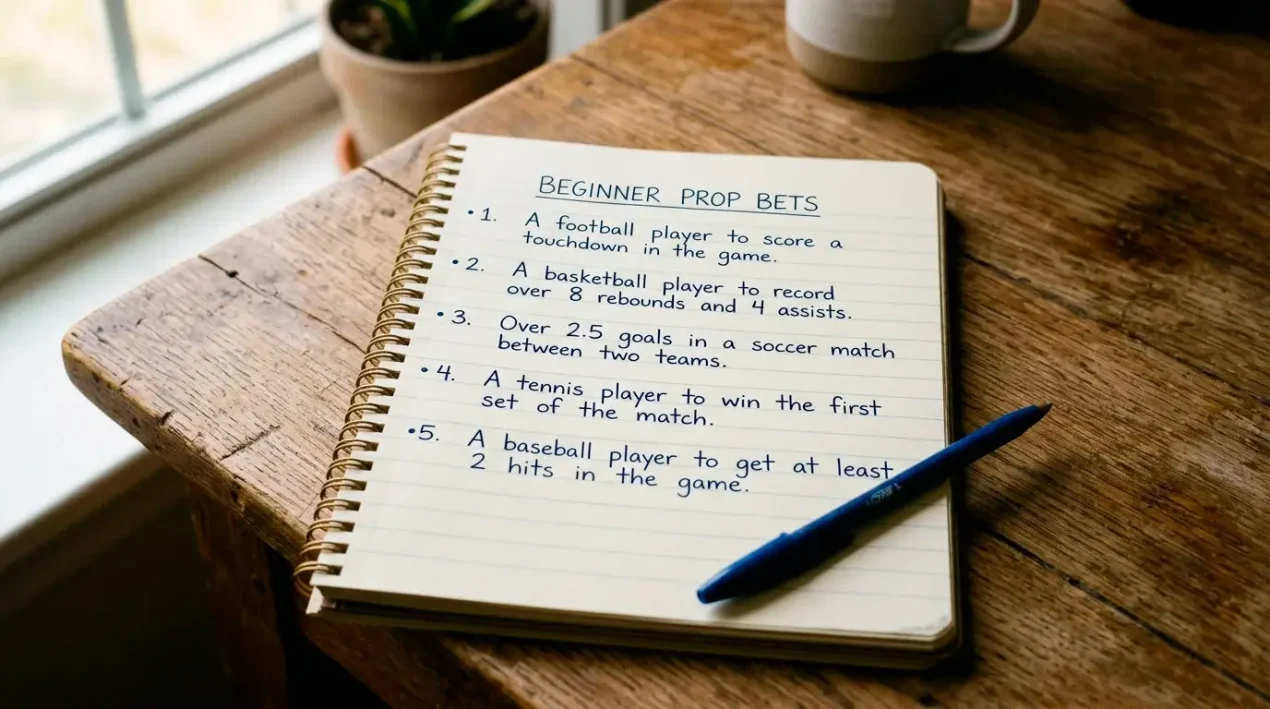
Recommended First Prop Bets for UK NFL Beginners
The first NFL bet I ever placed in the UK was a five-leg accumulator that cost me £20 and lost on the fourth leg in roughly the most painful way possible. If I had the same £20 again, I would not place an accumulator. I would place a single anytime touchdown scorer bet on a lead running back I had a clear read on, watch the game with a beer, and finish the experience feeling like I had understood the market instead of having been steamrolled by it.
That is the lesson I want to lead with. There are 13 million NFL fans in the UK and the league has been growing fast – Henry Hodgson, the NFL UK GM, framed where things are heading: “There’s a lot of growth, and the UK is at the centre of that international growth as well.” More UK punters are entering the prop market every season. Most of them do what I did. The point of this piece is to give you a working framework so your first five bets are decisions, not lottery tickets.
Picking your first bookmaker
Before any bet, the operator. The single requirement that matters for a beginner is a UK Gambling Commission licence. The UKGC public register lists every licensed operator; if a sportsbook does not appear, do not deposit with it. The licence is what guarantees withdrawal speed, dispute resolution, responsible gambling tools and basic consumer protection.
Beyond the licence, the criteria worth checking before your first deposit are practical. Does the operator offer NFL prop markets at all, not just basic match-result betting? How wide is their NFL prop tree on a typical Sunday – somewhere between 50 and 150 player markets is the working range for a usable operator. How clear is the cash-out and partial cash-out policy. How fast is the typical withdrawal speed. The biggest UK operators process around 99% of customer withdrawal requests within 24 to 48 hours of the request being made, which is the standard you should expect.
What I would actively avoid as a beginner: any operator that requires you to chase a complicated bonus to get fair pricing, any operator that posts NFL props only for the biggest fixtures rather than every week, and any operator whose interface buries the prop markets behind multiple taps. The product needs to be usable on a Sunday afternoon while you are also trying to watch the game. Complicated interfaces lead to mistyped stakes and bets on the wrong selections, both of which I have done.
The five starter prop types
The first five bets I would suggest a beginner work through are designed to teach the mechanics of different markets without overcomplicating any single decision. They are not the highest-EV bets in the world. They are the bets where the settle logic is clearest and where you can learn what each market actually does.
First: an anytime touchdown scorer bet on a starting running back on a favourite. The bet wins if your selected back scores a touchdown at any point in the game. The price is typically in the 5/4 to 7/4 range. The bet is intuitive – you are predicting that one specific player will reach the end zone – and the resolution is binary. You learn the most-bet single player prop in the NFL market.
Second: a passing-yards over/under on a starting QB. Pick a QB whose season average is comfortably above the bookmaker’s line and bet the over. The price is usually around evens or slightly worse on either side. The bet teaches you to read passing-yard ranges (a standard QB line sits between 250 and 300 yards) and to think about volume rather than just outcomes.
Third: a receiving-yards over on a starting wide receiver. Same mechanic as passing yards but at the receiver level. Standard lines run 3.5 to 7.5 receptions and 40 to 90 receiving yards for headline starters. This bet teaches you to think about target share and matchup rather than just season totals.
Fourth: a match-winner bet (the UK term – the US equivalent is moneyline) on the favourite of a game. Yes, this is not technically a player prop, but it teaches you the price structure of NFL betting and the relationship between spread, total and outcome. Pick a favourite of 4 to 7 points, accept the short price, and learn how an NFL game’s flow shapes the result.
Fifth: a small-stake same-game parlay built around shared logic – for instance, a starting QB’s passing-yards over plus his WR1’s receiving-yards over. Two legs only. The SGP teaches you the correlation product and the parlay math. Two legs is enough to feel the multiplier without the overload of a five-leg bet.
Stake sizing for the first month
The single most important decision in your first month is not which bets to place but how much to stake on each. Beginners overstake almost universally – chasing a “good week” of betting numbers by sizing up after wins, sizing up after losses to recover, or simply matching the headline numbers seen in adverts.
The discipline I would suggest is a flat unit of 1% of your total NFL bankroll on each bet, with a hard cap on weekly losses at 5% of bankroll. If your bankroll is £500, your unit is £5 and your weekly loss cap is £25. Once you hit the cap, you stop for the week. The cap is not a target – it is an emergency brake. Most weeks you should be well under it.
The £150 net deposit / 30-day threshold that UK operators use as a financial vulnerability anchor is a useful behavioural reference. If you find yourself depositing close to that threshold in your first month, that is the bankroll telling you it is too small for the stakes you are running, or the stakes telling you they are too high for the bankroll. The threshold exists because operators have data showing that crossing it is the point where many users start running into trouble. Treating it as a personal speed limit is sensible, regardless of what the regulator requires.
Tracking your bets matters more than the bets themselves
The single behavioural change that has improved my results more than any analytical insight is logging every bet in a spreadsheet. Date, fixture, market, selection, stake, odds, result, profit/loss. Five minutes per Sunday. After three months you have a real data set on what kinds of bets you actually win and lose on, and the data set is invariably different from what you would have predicted at the start.
The patterns that emerge from a personal log are uniquely instructive. Most beginners discover that they over-bet anytime TD scorers on their favourite team. Most discover that their SGP win rate is dramatically below their straight-bet win rate, even when individual legs are sound. Most discover that they consistently lose money on Monday Night Football because they have stayed up too late to make good decisions on the prices.
The simpler version of this is a betslip review every Sunday evening. Did any of your bets fail for a reason you could have foreseen? Did the line move against you between when you placed the bet and kick-off? Did you stake more than your usual unit on any bet, and why? Honest answers to these questions in your first month set the foundations for a long-term betting habit that is actually under your control.
The behaviours that protect you from learning expensive lessons
A few habits to cultivate from your first bet. Never bet on a market you do not understand the settlement rules of. If you cannot explain in one sentence how the bet wins or loses, you should not be placing it. Anytime touchdown scorer is easy. Same-game parlay with seven correlated legs and exotic alt-lines is not.
Never place a bet because the price looks attractive. The price looks attractive because the bookmaker has priced it to look attractive. The question is not “is this a long shot at good odds” – it is “does my estimate of the probability suggest the price is fair”. If you cannot answer that question, you are not making a bet, you are buying a ticket.
Never deposit money on Sunday morning to cover a bet you want to place. If you do not have the bankroll on Saturday night, you do not have the bankroll on Sunday morning. The behavioural pattern of deposit-and-chase is the single most reliable indicator that something has gone wrong with your relationship to betting, and the £150 affordability check exists precisely because the regulators have seen the data on what happens to people who cross that line repeatedly. The opt-in marketing rules that took effect across UK operators in May 2025 also mean you will receive far fewer unsolicited promotional emails pushing you toward bets – the absence of pressure marketing is in your favour, and it is worth treating that absence as a feature, not a bug.
What’s a sensible first-month stake unit for an NFL prop bettor in the UK?
A flat unit of 1% of your total NFL bankroll on each bet, with a hard weekly loss cap of 5%. For a £500 bankroll that’s £5 per bet and £25 weekly maximum loss. The discipline is more important than the exact numbers – what matters is choosing a unit you can stick with through both winning and losing streaks without revising it upward in either direction. Beginners who size up after wins or chase losses by sizing up after losses tend to have shorter and more expensive learning curves.
Which simple prop type has the easiest settle logic for a complete beginner?
Anytime touchdown scorer is the cleanest. Your selected player either scores a touchdown at some point during the game or he doesn’t. There are no fractional outcomes, no half-yard pushes, no scoring methodology to learn. The one nuance worth knowing – a quarterback’s passing touchdowns don’t count for his own anytime TD bet, only his rushing touchdowns do – is the one trap to remember up front, but it doesn’t affect the basic settle logic on running backs, wide receivers or tight ends, which is where most beginner bets land anyway.
Once the basic prop types make sense, the next read for translating the US-flavoured terminology into the British market is my full glossary of NFL betting terms translated for UK punters.
This material was created by the YardLedger team.
Related posts

Passing Yards Prop Strategy for NFL: Reading Lines, Pace and Defensive Context
NFL RB Committee Prop Strategy: How to Bet Backfields That Refuse to Anoint a Workhorse