NFL Longest Play Markets: Pass and Run Props
 Available in US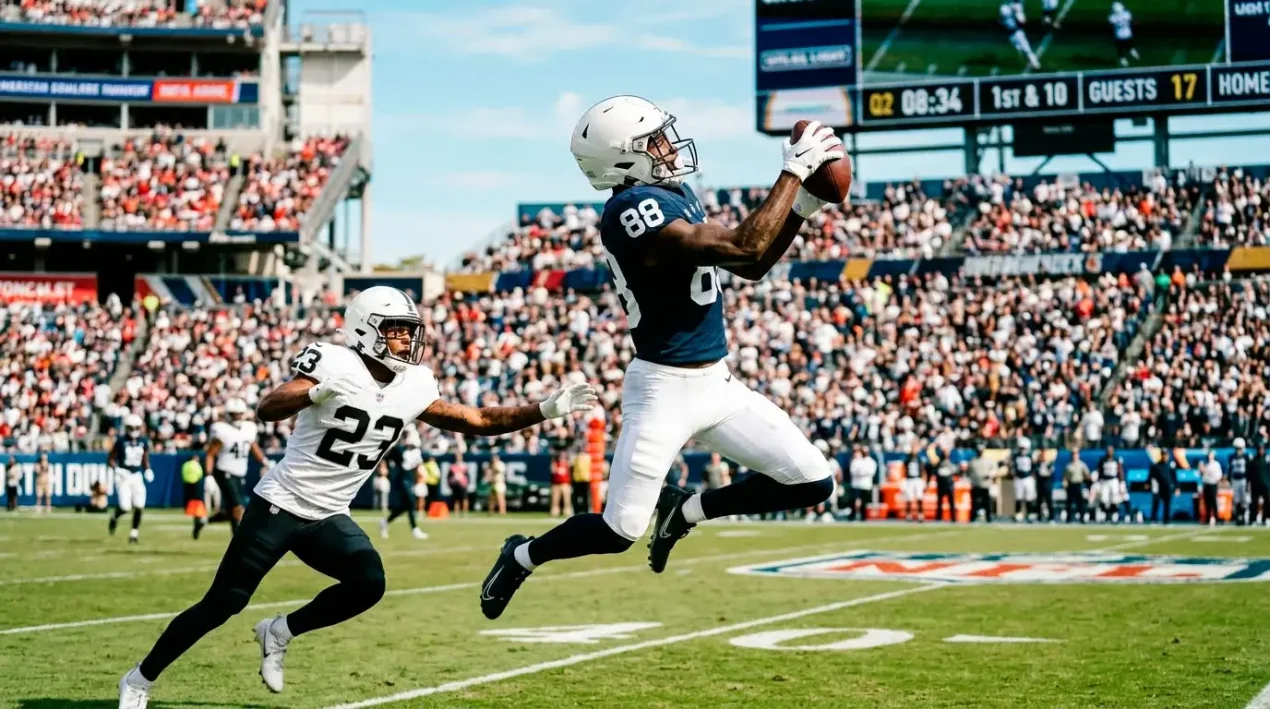
Pricing Explosive Distribution in Longest Play Markets
Late in a Sunday afternoon game I had largely written off, with most of my prop slate already settled and the result mostly known, a receiver I had placed a “longest reception over 35.5” bet on broke a slant for 28 yards, broke a tackle, and took it the rest of the way for a 67-yard touchdown. The bet was at +145, the stake was small, and the cash-in was almost an afterthought relative to the rest of the day’s P&L. But that one play taught me something the rest of the slate had not: the longest-play markets behave differently from yardage markets, and most casual bettors do not price them right because they reason from total volume rather than from the right tail of the per-play distribution.
Longest-play markets are about explosive plays, not aggregate production. A receiver who catches 8 passes for 80 yards has identical receiving-yards stats to one who catches 4 passes for 80 yards – but the longest reception in the second case is by definition longer, because the average per catch is higher. The market sometimes prices these two profiles similarly when it should not, and that is where the consistent edge lives.
The structural differences from yardage markets
The standard NFL receiving-yards or rushing-yards market is essentially a bet on aggregate volume across 5 to 15 plays. The total yardage smooths out individual play variance, and the resulting line is centred near the player’s expected production with a relatively tight distribution. The longest-play market is the opposite – it depends entirely on whether any single play exceeds a threshold, which means the distribution is heavily right-tailed and small probability mass at the long end translates to meaningful expected value.
The math is straightforward but unintuitive for casual bettors. A receiver with 6 expected receptions averaging 13 yards each has an expected receiving-yards line of 78. The same receiver’s longest-reception expectation, however, is not just “the average per catch”. It is the maximum value across 6 attempts drawn from a per-play distribution. If his per-catch yards follow a typical NFL receiver distribution (heavy mass around 8-12 yards, modest mass at 15-25, thin mass at 30-plus), his expected longest reception is closer to 23 to 27 yards, not 13.
The implication is that longest-play lines should reflect the right-tail behaviour of the underlying per-play distribution, not the average per-play production. UK book pricing on longest-play markets sometimes captures this correctly, but often defaults to a simpler heuristic – proportional scaling from the standard receiving-yards line – that systematically underprices the right tail for explosive-style players and overprices it for grinding-style players.
The receiver-type distinction
The single most important variable for longest-reception markets is whether the receiver is a vertical-passing-game contributor or a possession-receiving contributor. Vertical contributors run go routes, post routes, deep crosses – high-yardage-per-catch concepts with substantial right-tail probability on any given target. Possession receivers run hitches, slants, drag routes, screens – high-target-share concepts with low yardage-per-catch and minimal right-tail.
A vertical receiver with 4 expected targets has a higher longest-reception expectation than a possession receiver with 8 expected targets, even when their total receiving-yards expectations are similar. The market often does not differentiate strongly enough between the two profiles, particularly when both players have similar season-average receiving-yard production. The result is that longest-reception over bets on vertical receivers, at threshold lines set proportionally to their standard receiving-yards line, are structurally underpriced.
The 2025 international games drew average viewership of 6.2 million across NFL Network broadcasts, a 32% increase year over year, and the growth has expanded UK casual punter attention on the headline vertical receivers – the names with viral highlight reels of long touchdowns. Henry Hodgson, the NFL UK GM, framed the trajectory: “There’s a lot of growth, and the UK is at the centre of that international growth as well.” The attention concentration on these names has tightened pricing on their longest-reception markets specifically, but the analogous WR2 vertical receivers – second-tier players with similar route profiles – remain relatively soft on the longest-play side.
The longest-rush market and breakaway speed
Longest-rush markets follow similar right-tail logic, with the running back’s running style as the key differentiator. Backs who run primarily inside, between the tackles, in gap-scheme power-running offences have low per-carry variance – most runs gain 2 to 6 yards, with occasional 10-to-15 yard gains and rare breakaways. Their longest-rush distribution has thinner right tails.
Backs who run primarily outside, in zone-blocking schemes with breakaway speed (sub-4.45 forty-yard times, in the typical NFL frame), have much heavier right-tail distributions. Their per-carry distribution has the same average as a gap-scheme back’s, but with more probability mass at 15-plus yards and meaningful mass at 25-plus yards. Their longest-rush expectation on 18 carries is substantially higher than a comparable gap-scheme back’s, even at identical total rushing-yards projections.
The market pricing on longest-rush over bets sometimes captures this, but the differentiation is often coarser than the underlying probability would justify. A breakaway-speed back facing a defence ranked in the bottom half against the run, with the team projected for moderate-favourite script, is the cleanest longest-rush over setup. The price targets are typically at thresholds around 20 to 25 yards, with offered prices at -110 or longer on the over side.
The kickoff and punt return longest-yardage angle
Return-yardage markets exist on most UK books for designated kick and punt returners, and the longest-return alt lines are a particularly inefficiently priced subcategory. The base rate for kickoff returns has shifted substantially in recent years as rule changes have reduced the volume of full returns, but the right-tail behaviour of the remaining returns is dominated by a small number of high-acceleration returners who consistently break long gains when given runway.
The longest-kickoff-return alt line typically lists thresholds at 5-yard intervals from 20 yards up to 50 yards. The offered prices imply probability distributions that are sometimes substantially below the true probabilities for top-tier return men. A designated returner with 3 expected kickoff returns per game has a non-trivial probability of breaking one for 40-plus yards in any single game – perhaps 15% to 20%, depending on the team’s blocking scheme and the opposing kickoff coverage quality. The offered price at the 40-plus threshold often sits at +700 or longer, implying 12% or less. The over has structural value for top return specialists in plus matchups.
The punt-return market follows similar logic but with even thinner right-tail probability mass, because punt returns happen less often than kickoff returns and the variance per return is higher. The longest-punt-return alt line is most attractive when the opposing team is projected to punt frequently – a heavy underdog with a strong defence projected to limit a high-powered offence to short drives, leading to many punts on the night.
The longest-pass-completion market and the QB factor
The longest-completion market sits at the intersection of QB selection, receiver matchup, and offensive scheme. The key differentiator is the QB’s willingness to attempt deep passes. Some QBs throw 4 to 6 attempts of 20-plus air yards per game; others throw 1 to 2. The longest-completion distribution for the first group is meaningfully wider than for the second, even at comparable total passing-yards projections.
The matchup factor is opposing-defence coverage style. Defences playing predominantly two-high safety shells (Cover 2, Cover 4) make deep completions harder, because the safety help is positioned to bracket vertical routes. Defences playing single-high coverage with Cover 1 or man-pressure looks are more vulnerable to long completions because the safety help is reduced. The matchup of a vertical-attempt-heavy QB against a single-high defence is the structurally favoured longest-completion over setup.
The Pickswise prop ledger that ran to 59 winning props and +7.7 units across the regular season, wild card, divisional and conference rounds had a small but persistent contribution from longest-completion over plays. The hit rate was lower than for standard prop categories, but the price multiplier on hits made the plays selectively profitable across the season-long sample.
The first-touchdown-distance and longest-touchdown markets
UK books sometimes offer specialised long-play TD markets – “distance of first touchdown over 10 yards”, “longest touchdown of the game over 30 yards”, and similar variants. These markets layer the longest-play logic on top of touchdown probability, which compounds the right-tail behaviour but also compounds the variance.
The structural fact: 24 of the last 35 Super Bowls have featured a touchdown scored from the 1-yard line, around 60% of championship games. That base rate creates an asymmetric structure for first-TD distance markets. The under on “first TD distance over 5 yards” is structurally well-supported by the goal-line touchdown pattern, even when the offered price implies 50% or less probability. The implication is that “first TD under X yards” plays in projected-grindout matchups are sometimes meaningfully underpriced.
The longest-TD over markets, conversely, depend on the same offensive scheme and matchup variables that govern other long-play markets. A vertical-passing-game team facing a single-high coverage defence has a higher probability of producing a long TD than the standard market price implies. The lines are typically set at thresholds of 25, 30, 40 or 50 yards, with offered prices ranging from -110 at the lowest thresholds to +400 at the highest.
The variance discipline for longest-play portfolios
Longest-play bets are the highest-variance category in the standard prop universe, with hit rates that depend heavily on the threshold level chosen. Conservative thresholds (e.g., longest reception over 20 yards on a vertical receiver) hit at 55% to 65% rates at -110 pricing. Aggressive thresholds (longest reception over 40 yards on the same receiver) hit at 15% to 25% at +300 pricing. The expected-value calculations land in similar territory across the range, but the variance profile is wildly different.
The disciplined approach is to spread longest-play exposure across multiple threshold levels rather than concentrating on a single point. A bettor with a strong read on a vertical receiver in a single-high matchup might bet the longest-reception over at 25.5 at -110 for 1% of bankroll, plus the over at 35.5 at +150 for 0.5% of bankroll, plus the over at 50.5 at +500 for 0.25% of bankroll. The combined position captures the conservative-threshold base rate plus right-tail upside, with the position sizing reflecting the variance profile of each threshold.
The Entain-reported 65% year-over-year increase in NFL bettor volume after the 2024/25 season, with stakes up 46%, has poured casual UK money into the longest-play category, which is one of the marketed-as-glamorous prop products. The compensating opportunity is that the casual money tends to concentrate on extreme long-shot thresholds (longest reception over 50-plus on headline names), leaving the conservative-threshold bets on second-tier specialist players relatively undermarketed and consequently better-priced for the disciplined punter.
How do NFL longest-play markets differ from standard yardage markets?
Standard yardage markets bet on aggregate volume across the entire game, which smooths out per-play variance and produces a relatively tight distribution around the offered line. Longest-play markets bet on the right tail of the per-play distribution – the single largest play of the game – which is heavily skewed and depends on the underlying receiver, runner, or return type. A vertical receiver with high yards-per-catch has a much wider longest-reception distribution than a possession receiver with the same total receiving-yards expectation, and the market sometimes does not price this differentiation strongly enough.
Which longest-play markets offer the best value for UK punters?
Longest-reception over bets on second-tier vertical receivers, longest-rush over bets on breakaway-speed running backs in zone-blocking schemes, and longest-return alt lines on top-tier kickoff and punt returners are the three most consistently mispriced categories. The structural reason is that casual UK money concentrates on the headline names in each category, leaving the second-tier vertical specialists with similar route profiles or running styles relatively underpriced on their longest-play markets. The selection discipline requires identifying the per-play distribution shape, not just the aggregate yardage projection.
If longest-play thinking sharpens your interest in the responsible-betting tools that protect bankrolls across high-variance market categories, the related read is how GamStop and UK player-protection tools fit alongside disciplined NFL betting.
This material was created by the YardLedger team.
Related posts

Passing Yards Prop Strategy for NFL: Reading Lines, Pace and Defensive Context
NFL RB Committee Prop Strategy: How to Bet Backfields That Refuse to Anoint a Workhorse