
Fantasy Football Skills for NFL Player Props
 Available in US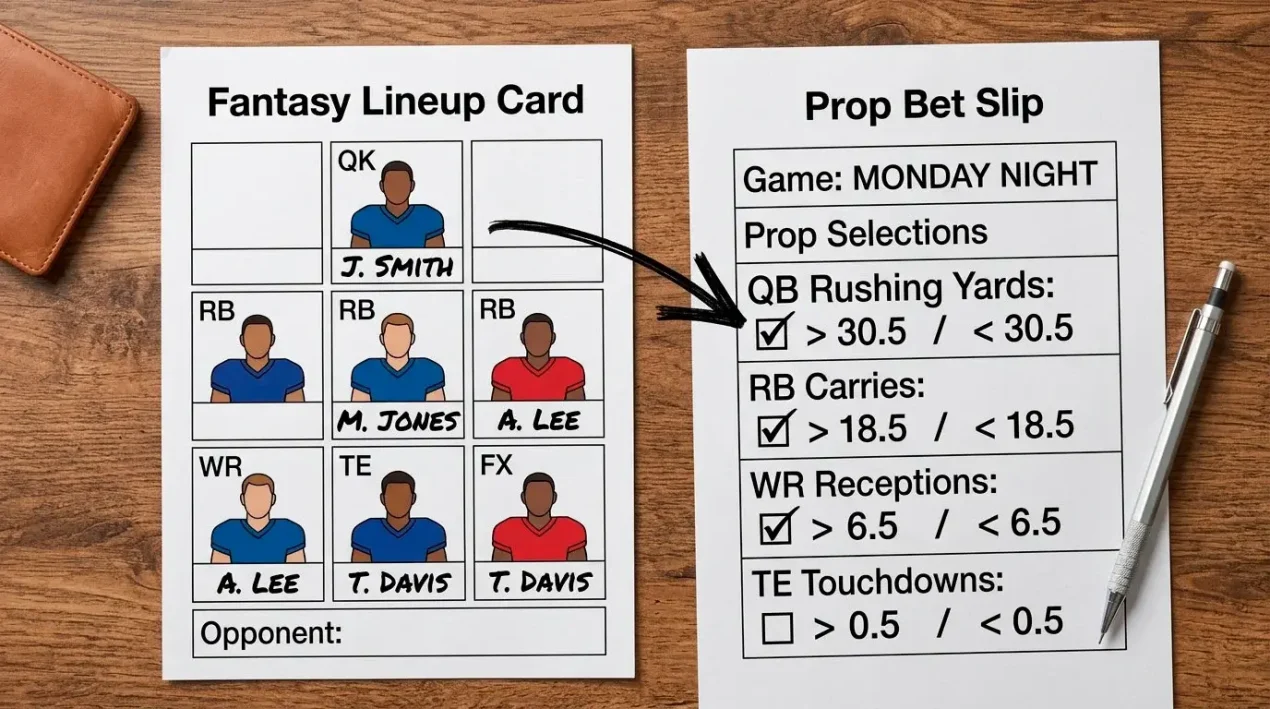
Translating Fantasy Projections to Profitable Prop Bets
A friend of mine ran one of the best fantasy football teams in his league four years running. He drafted shrewdly, worked the waiver wire, and made trades that other managers regretted within a fortnight. When the UK NFL prop market took off and he started betting player props on the side, he assumed his fantasy edge would translate directly. By Week 8 of his first betting season, he was down about £400. He could not understand it. He knew the players better than anyone in his league. He understood usage trends, target shares, snap counts. He was right about who would score points. But he kept losing prop bets.
The reason, once I dug into his bet history with him, was both simple and important. Fantasy football and prop betting reward overlapping but materially different skills. Picking the player most likely to score the most fantasy points is not the same as picking the prop line most likely to be wrong. He had a fantasy edge. He did not yet have a betting edge. The translation between the two is real but it is not automatic, and the rest of this piece is about the parts that carry over, the parts that do not, and how to convert one set of skills into the other.
Where the skills genuinely overlap
The first place fantasy expertise pays dividends in prop markets is volume projection. A good fantasy manager has spent years learning how to anticipate touches, targets, and red zone work. Those are the same inputs a prop bettor needs. If you can read a Wednesday practice report and estimate that a slot receiver will see 8 to 10 targets on Sunday, you have most of what you need to evaluate his receptions over/under line. The mechanics of converting usage projection into a number are essentially identical across the two disciplines.
The second carryover is matchup analysis. Fantasy players already think in terms of how a defence allocates pressure, how cornerback assignments shift, how a coordinator might game-plan an opposing team. Those analyses translate directly to prop evaluation. The cornerback shadowing the WR1 affects fantasy points and the receiving-yards line in exactly the same way. The pass-rush metric that makes you bench a QB in fantasy is the same metric that makes his passing-yards under attractive in a betting context.
The third overlap is injury and inactives awareness. Fantasy players are obsessive about the inactives list because a 9:30 announcement can wreck their lineup. Prop bettors should be obsessive for the same reason. The 1.2 million UK NFL searches per month spike sharply on Sunday morning, partly because that is when injury news breaks and partly because UK punters are checking lines that just moved. Fantasy managers already know how to interpret beat-writer tweets and parse “limited in practice” versus “did not practice”. That instinct transfers cleanly.
Where the disciplines diverge
The single largest mental shift moving from fantasy to props is the framing of value. Fantasy points are absolute. The objective is to maximise total points for your roster against an opposing roster. Prop bets are relative to a line. The objective is not to identify the player who will score the most points; it is to identify the line that is mispriced by more than the bookmaker’s vig.
This sounds abstract until you see how it plays out in practice. Suppose a top-tier wide receiver has a receiving-yards line at 92.5. The fantasy answer to “is he going to be good this week” is “yes, he is one of the best in the league, start him”. The prop answer to “is his over at 92.5 a good bet” is “well, 92.5 is already a high line that prices in his being one of the best in the league, so the over depends on whether the actual median outcome in this matchup is higher than 92.5”. The fantasy player is rewarded for picking elite players. The prop player is rewarded for picking elite mispricings. They are different questions.
The second divergence is sample size. Fantasy decisions are made weekly, and the season ends with you having made about 17 starting-lineup decisions per roster slot. Variance dominates. A good fantasy manager can lose to a bad one in any given week. Prop bettors, by contrast, are typically placing hundreds of bets per season. The variance smooths out over the sample, but the implication is that prop betting requires bankroll discipline and consistent stake sizing in a way fantasy never demands. You do not blow up a fantasy roster with poor bankroll management. You blow up a prop bankroll if you treat each bet as standalone.
The translation framework that actually works
What I have my fantasy-first friends do when they want to add prop betting is a simple three-column exercise. For each player they would consider starting in fantasy, they write down: their projected stat line, the current over/under from a UK book, and the implied probability that the over hits at the offered price. The third column is the one fantasy thinking does not generate naturally, and it is the one that matters.
The implied probability calculation is straightforward. Odds of -110 imply a roughly 52.4% break-even rate. Odds of -120 imply about 54.5%. The question becomes whether your projected stat line crosses the over/under at a rate higher than that implied probability. If your projection has a 60% chance of hitting the over and the book is asking you to be right at 52.4%, you have an edge. If your projection has a 55% chance and the book is asking 54.5%, the edge is too thin to play given the variance.
This is the moment the friend I mentioned earlier started turning his fantasy edge into a betting edge. He had always done the projection work. He just had not been translating it into a probability he could compare to the price. Once he started, his bet selection narrowed dramatically. He went from placing 20 bets a week to placing four. Volume dropped, hit rate climbed, and his bankroll started compounding rather than bleeding.
The TD scoring puzzle that fantasy primes you for
One area where fantasy experience is genuinely valuable is touchdown prediction. Anytime touchdown scorer is one of the most popular UK NFL prop markets, and fantasy managers have already spent years thinking about which players are most likely to find the end zone. Red zone work, goal-line carries, target share in scoring position – these are bread-and-butter fantasy concepts that translate directly into anytime-TD evaluation.
The under-appreciated fact that helps in this market: 24 of the last 35 Super Bowls have featured a touchdown scored from the 1-yard line, around 60% of championship games. That is a base rate worth carrying in your head, because it tells you that goal-line TDs are common enough that the player getting goal-line work has a meaningfully higher floor than his per-game numbers might suggest. Fantasy managers already know who the goal-line back is. The prop translation is to recognise that the goal-line back is consistently underpriced on anytime TD relative to his actual probability, especially in plus-matchup spots.
Laura Louisy, anchor of Sky Sports’ rolling NFL coverage, framed the UK fan progression in a way I think fits the fantasy-to-betting journey: “It allows us to do so much more for those fans of the sport that are dedicated and want more depth.” That depth, in the betting context, is exactly what the move from fantasy projection to prop evaluation requires. You stop thinking about who will score and start thinking about who is mispriced to score.
The traps fantasy thinking pulls you into
The most common trap I see is the “stars and scrubs” instinct. In fantasy, you build around elite players and accept that the depth of your roster will be uneven. In prop betting, that same instinct leads to betting only top-tier players, who are the ones with the most efficient pricing. The lines on Patrick Mahomes, Tyreek Hill or Christian McCaffrey are sharper than the lines on a mid-tier WR2 or a backup QB getting a start. The market has priced the stars closely; the mispricings are more common on the second-tier names.
A second trap is the recency-bias problem fantasy managers already know about but somehow forget when betting. The receiver who had 140 yards last week is the one your fantasy gut wants to start, but he is also the one whose receiving-yards line has been pumped 8 to 10 yards by the book this week to reflect that performance. If you are buying the over on a player coming off a huge game, you are paying for last week’s outcome in this week’s line. Fantasy lineup decisions can absorb that bias. Bet decisions cannot.
The third trap is overestimating the value of “knowing the player”. Fantasy managers know who their guys are. That intimate knowledge can convert into confirmation bias when betting. You bet your guy’s over because you “know” he is good, when the line on him is already incorporating his being good. The discipline of asking “what would the market need to be wrong about for this bet to win” is the antidote.
The Sunday morning workflow worth building
The workflow that converts fantasy preparation into prop opportunity is built around the inactives window. UK Sunday mornings between 12:30 and 5:30 local time are the active period for Week 9-onward prop adjustments, because that is when status confirmations arrive from US team beat writers. Fantasy managers already check this window for start/sit decisions. The extension to prop betting is to also check whether the line on a now-elevated backup, or a now-confirmed-active starter, has updated to reflect the new information.
The opportunities are largest in the 30-to-60 minute window after a status is confirmed. If a starting RB is ruled out at 12:30, the backup’s anytime-TD price should compress significantly. Some UK books reprice within minutes; others take longer. The lag is your edge, and fantasy managers who are already on the inactives bell are positioned better than anyone to catch the price before it moves. The Pickswise prop ledger that tracked 59 winning props for +7.7 units across the regular season, wild card, divisional and conference rounds was disproportionately built on these post-status-update spots – the value of confirmed information that the market has not yet fully processed.
What I have my friend do now: he runs his fantasy lineup decisions Saturday night, then on Sunday morning he checks the inactives, identifies which props the inactives have repriced, and picks one or two to bet based on the disparity between the new market price and his updated projection. He places one to three prop bets per Sunday, sized at 2% of his bankroll each. His hit rate has stabilised in the high fifties, which is profitable at standard prop pricing. He has not given up fantasy. He just has a second skill stacked on top of the first.
The handoff to live betting and beyond
Once the fantasy-to-prop translation has settled in, the next natural extension is the same skill applied to in-game markets. Live prop lines reprice as games unfold, and a fantasy manager who is good at reading game flow has a head start. Fantasy intuition about how usage shifts under different scripts becomes a live-betting weapon when you train yourself to convert it into a probability comparison rather than a hot-take call. The career arc from fantasy player to disciplined prop bettor takes seasons, not weeks, but the skills are the closest available adjacent set.
Will my fantasy football skills give me an edge in NFL prop betting?
A partial edge, not a full one. The skills that transfer are volume projection, matchup analysis, and injury and usage awareness. The skill that does not transfer automatically is converting your projection into a probability and comparing it to the market price. Fantasy rewards picking elite players. Prop betting rewards picking elite mispricings. Once you build the second habit on top of the first, fantasy preparation becomes a genuine asset.
Which fantasy concepts translate most directly to prop bet evaluation?
Three transfer cleanly. Volume projection (targets, carries, snap counts) is the input that drives both fantasy points and prop yardage lines. Matchup analysis (cornerback shadows, pass-rush rate, defensive scheme) shapes both fantasy decisions and prop value. Inactives and injury reads are the same skill in both contexts. The conceptual addition you need on top is implied probability from prop odds, which lets you decide whether your projection clears the market price.
If the next step is putting fantasy-informed projections to work in the most heavily punted UK NFL market, the read that pairs with this one is the framework for evaluating anytime touchdown props in UK books.
This material was created by the YardLedger team.
Related posts

Passing Yards Prop Strategy for NFL: Reading Lines, Pace and Defensive Context

NFL RB Committee Prop Strategy: How to Bet Backfields That Refuse to Anoint a Workhorse