NFL Primetime Game Betting for UK Punters: Why Thursday, Sunday and Monday Night Demand Different Plays
 Available in US
The 2 a.m. Tuesday morning I almost slept through my own bet
My first Monday Night Football bet in the UK was a passing-yards over on a star QB in a divisional matchup. I placed the wager at 11 p.m. Sunday, told myself I would set an alarm for 1:30 a.m. to catch kick-off, and went to bed. The alarm did its job. The QB did not. He threw for 158 yards before halftime, then 47 in the second half. The under cleared by 70 yards. As I switched off the laptop at 4:15 in the morning, the question in my head was not whether I should have bet differently, but whether I should have been betting that game at all.
UK NFL primetime is a different product from US NFL primetime, and the difference shapes which bets are sensible and which are essentially recreational. The time zone, the broadcasting context, the fatigue factor, the line-movement timing – all of these create dynamics that the standard Sunday-afternoon prop framework does not fully address. Working through those dynamics is what separates UK punters who get value from primetime bets from those who just stay up late to lose money.
The Thursday Night problem and what it costs you
Thursday Night Football is the primetime slot with the biggest structural disadvantages for prop bettors. Teams play with four days of rest instead of the usual seven, which compresses preparation time, increases injury impact, and makes coaching adjustments harder to implement. The result is meaningfully more variance in individual player performances on Thursday than on Sunday.
The data on Thursday-versus-Sunday performance has been studied repeatedly, and the consistent finding is that Thursday games produce more outlier results in either direction. A starting QB is more likely to have a 380-yard game than on a Sunday because game scripts go sideways more frequently on short rest. He is also more likely to have a 165-yard game because the offence has had less time to install adjustments for the opponent. The variance cuts both ways, which means prop unders and overs are both harder to project on Thursday than on Sunday.
The implication for UK punters is that Thursday Night Football is the worst weekly primetime slot for high-conviction prop plays. The kick-off is 1:15 a.m. UK time. The variance is structurally higher. The fatigue factor for the bettor is real. My honest position is that Thursday Night Football is a recreational viewing experience for UK fans more than a serious betting opportunity, and the cleanest discipline is to size Thursday positions at a quarter to half of normal stake. The exception is large-edge spots created by injury news close to kick-off, which can be played at full size because the source of the edge is informational rather than projection-based.
Sunday Night Football and the prep advantage
Sunday Night Football is the cleanest primetime betting slot, and the reason is straightforward. Both teams have had a full week of preparation, the marquee fixture quality is consistently high, and the kick-off time of around 1:20 a.m. UK Monday is late but not impossibly so. The viewing experience is essentially a normal NFL Sunday played one game at a time, which makes in-play and live-prop betting easier to manage than during the chaos of Sunday afternoon’s slate.
The line quality on Sunday Night is meanwhile sharper than on the Sunday afternoon games because the matchup is high-profile, gets covered intensely by the betting media, and attracts more sharp money. The implication is that pre-game prop markets have less obvious value than Sunday afternoon’s mid-tier fixtures. The compensating advantage is that live and in-play markets during Sunday Night Football are well-priced because the operators are paying full attention. You will not catch a stale line during Sunday Night Football, but you will get a market that responds quickly to game flow, which suits in-game prop bettors who are comfortable trading rather than buy-and-hold prop bettors.
For UK punters, the cash-out function on Sunday Night Football has practical use. A pre-game prop that is heading the wrong way midway through the third quarter is a candidate to cut at a partial loss rather than ride to settlement. The same applies in reverse for a prop that has cleared its line early – locking in a partial profit at the 9-yard line in a fourth-quarter goal-to-go situation can be a sensible move when the underlying outcome is no longer the player’s volume but a single goal-line snap.
Monday Night Football and the late-week information edge
Monday Night Football is the primetime slot where the broadest information advantage exists for UK punters. By Monday, all Sunday games have resolved, all weekend injury news has been confirmed, and beat-writer reporting on Monday’s two teams has had an extra 36 hours to surface. The line that was offered on Saturday has had two full days of context applied to it, but the line that is offered Monday morning UK time has had less than 12 hours to absorb the Monday-specific updates.
The implication is that Monday morning UK time is a meaningful window for line shopping. UK operators set their Monday Night lines on Sunday night US time, which is Monday morning UK time, and the price adjustments through the day Monday tend to lag the information flow. A starting WR who is downgraded on a Monday morning beat-writer tweet should compress his backup’s prop ladder in the same way a Sunday morning inactives announcement would. The market response is slower because the bandwidth of betting media attention on Monday is lower – most analysts have moved on from the previous slate and not yet fully focused on Monday Night.
The 2025 international games averaged 6.2 million viewers across NFL Network broadcasts, a 32% jump on the prior year. That growth pulls UK audience attention earlier in the week, including Monday Night Football, which has historically been the lowest-attention primetime slot for UK fans. As that engagement deepens, the Monday Night line inefficiencies are likely to compress over the next few seasons, but they have not yet – the window is open now for UK punters who are willing to do the Monday-morning reading.
The fatigue factor and how it changes your bet sizing
A bet placed at 11 p.m. Sunday for a 1:20 a.m. Monday kick-off is not a bet you can manage. You will not watch the game start-to-finish, you will not be in a position to live-cash-out at 3 a.m. if the script turns, and your follow-through on the bet is reduced in ways that affect outcomes you might think do not matter. The honest accounting is that primetime bets carry an implicit cost in attention and follow-through that Sunday afternoon bets do not.
My personal discipline, learned the hard way over multiple primetime seasons, is to halve primetime stake sizes relative to Sunday-afternoon stakes for the same edge. If a Sunday afternoon receiving-yards over represents a 60% chance of hitting at -110, I will bet it at 2% of bankroll. If the same projected edge appears on a Monday Night prop, I will bet at 1% – not because the projected edge is different, but because the variance I have control over (live-betting adjustments, cash-out decisions, mid-game observations) is materially reduced.
The other half of the fatigue discipline is selecting bets that resolve early. If a prop is settled by the second quarter (anytime TD, first TD scorer, alt-line passing yards), you can place the bet, watch the first half, and either celebrate or accept the loss by 3 a.m. Bets that need a full four quarters to settle, plus possible overtime, can drag past 4:30 a.m. and into territory where the day after is compromised. Early-resolving props are not always the best value, but they are the most manageable category for UK primetime betting.
The international slate as a primetime alternative
The international slate of nine games in 2026 – three at London venues, plus Dublin, Berlin, Madrid, Melbourne, Rio and Paris – is the closest thing UK punters have to “primetime at a normal hour”. The London games kick off at 2:30 p.m. or 6:30 p.m. UK time. The Dublin game kicks at a similar window. Berlin, Madrid and Paris are all afternoon UK kick-offs. Melbourne and Rio are early-morning UK kick-offs.
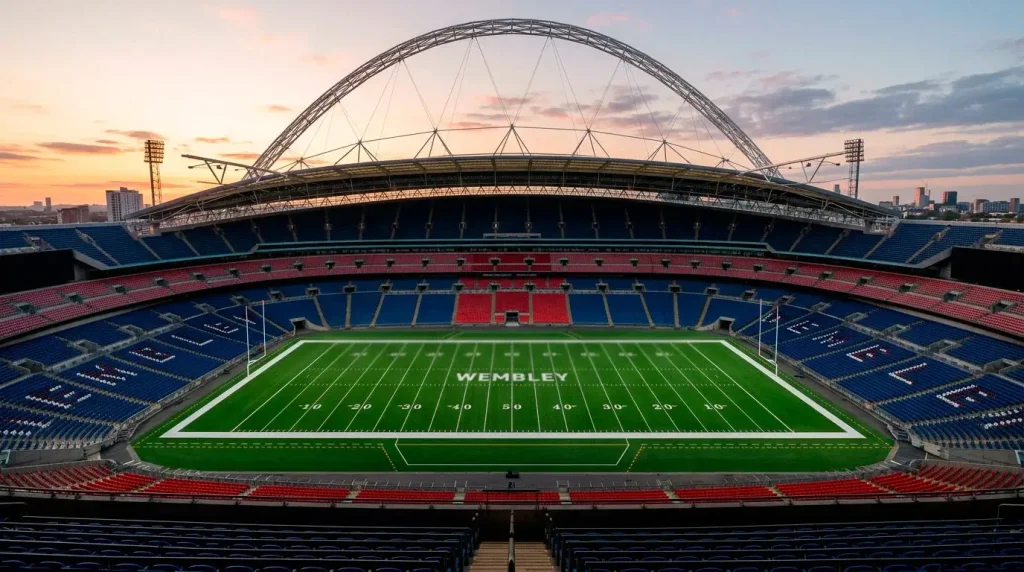
The structural advantage of international games for UK punters is that the time zone shifts the game to a manageable viewing window, which means the fatigue-driven stake reduction does not apply. You can bet international games at normal stake sizing because you can watch them, react to live information, and manage the bet through cash-out if conditions change. The 86,152 fans who attended Rams vs Jaguars at Wembley in 2025 were watching a fixture that, for UK betting purposes, behaves more like a Sunday afternoon Premier League game in terms of attention manageability than a Sunday Night Football game does.
The trade-off is that international games are heavily scrutinised by the betting media, including UK-focused outlets. Henry Hodgson, the NFL UK GM, framed the broader picture: “There’s a lot of growth, and the UK is at the centre of that international growth as well.” More attention typically means sharper pre-game lines and fewer obvious mispricings. The compensating opportunity is, as with all closely-priced markets, in live and in-play betting, where the UK audience is at full attention and the operators face a more competitive market structure.
The Saturday playoff window and what it changes
Late-season Saturday games – wild card weekend in particular – create a hybrid window that is neither Thursday’s short-rest variance nor Sunday’s normal-week stability. Saturday primetime kicks off in the late afternoon US time, which is late evening to overnight UK time. Wild card Saturday games are typically the most heavily bet NFL fixtures of the season by UK punters, because the playoff stakes elevate engagement and the kick-off times are more workable than Sunday Night Football.
The market dynamics are also different. Playoff prop lines reflect playoff intensity – typically lower scoring, tighter game scripts, more conservative coaching – and the lines that worked in the regular season often do not survive contact with the playoff matchup intensity. Specifically, passing-yards lines should be projected lower in playoff games than in regular season games against similar opponents, because the win-now intensity of playoff football changes coaching aggressiveness in ways that protect short-yardage outcomes over high-variance pass attempts.
UK Saturday playoff windows are also where line shopping has the most leverage, because the multi-day build-up to the fixture means UK operators are competing actively on the same markets. The Pickswise prop ledger that ran to 59 winning props and +7.7 units across regular season, wild card, divisional and conference rounds had a meaningful weight on the playoff Saturday sample – the structural attention from UK punters and operators creates conditions where the disciplined bettor’s edge is most pronounced.
What’s the latest UK kick-off time I should consider for prop betting?
The honest answer depends on your discipline rather than your enthusiasm. Sunday Night Football at around 1:20 a.m. UK time is the latest slot where pre-game prop bets remain manageable for most punters, provided you size positions conservatively and select bets that resolve early in the game. Monday Night Football at 1:15 a.m. Tuesday is the deepest reach. Thursday Night Football at 1:15 a.m. Friday is the most variance-heavy slot and the one I would size smallest. Any cash-out decisions you might want to make on these games require staying awake longer than most weekday schedules accommodate, which is itself a reason to size down.
Are international NFL games priced differently from US primetime games?
Pricing is similar in mechanics but the attention environment differs. International games attract concentrated UK media coverage and high punter volumes, which sharpens pre-game lines. The compensating advantage for UK punters is that the games are played at workable hours, which makes live and in-play betting practical at normal stake sizes. The pre-game mispricings are smaller than on a typical US Sunday afternoon, but the live-betting environment is more accessible than late-night US primetime games.
If primetime fatigue is pushing you toward markets that resolve quickly, the related read is the framework for evaluating anytime touchdown markets on UK books.
This material was created by the YardLedger team.
Related posts
Passing Yards Prop Strategy for NFL: Reading Lines, Pace and Defensive Context

NFL RB Committee Prop Strategy: How to Bet Backfields That Refuse to Anoint a Workhorse