
GamStop NFL Betting Limits and Player Protection
 Available in US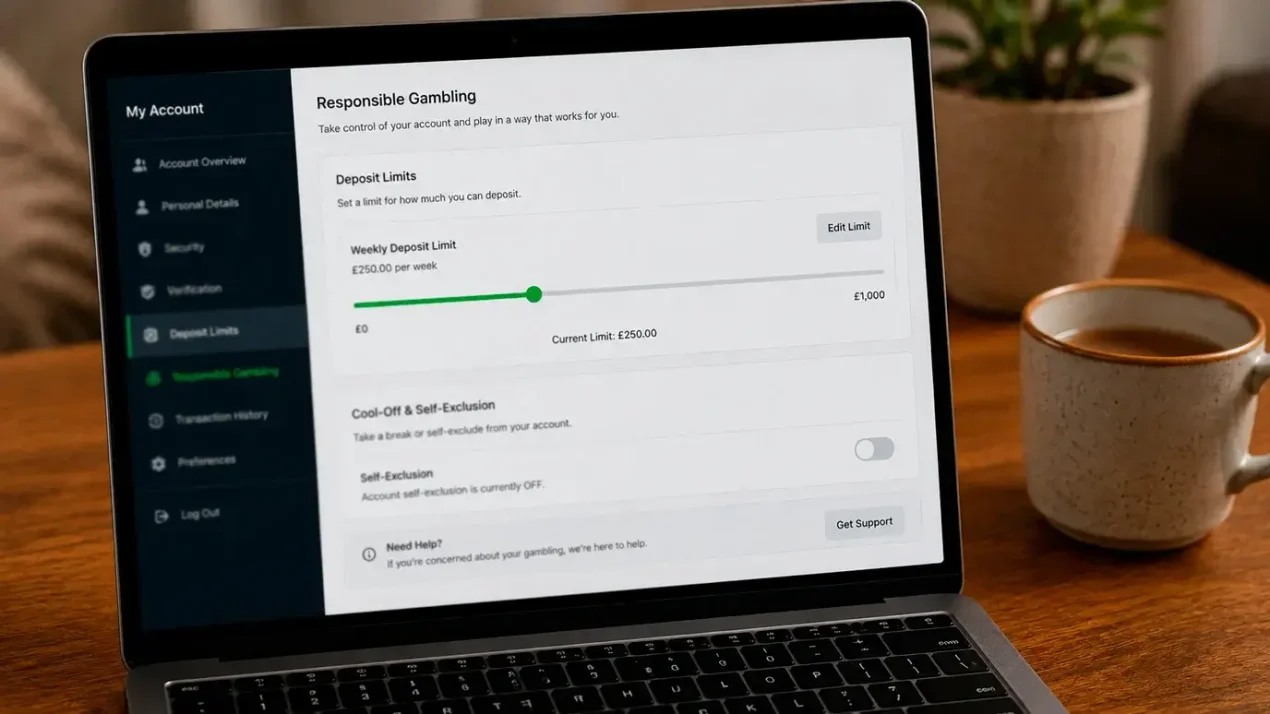
Proactive GamStop Use and NFL Betting Deposit Limits
A friend of mine, who had been betting NFL props alongside me for a couple of seasons, surprised me midway through Week 4 of a recent season by mentioning he had registered with GamStop. He had not been losing badly. He was not in distress. He had simply noticed that his Sunday-afternoon routine had started to feel less like deliberate analysis and more like reflexive logging-in. He registered for a six-month exclusion, took the break, came back four months later with a different rhythm, and has betted in much smaller volumes since.
That kind of pre-emptive use of player-protection tools is not what most punters think of when they hear “GamStop”. The framing in popular discussion tends to be that GamStop is for people who are in crisis. The actual design of the tool is much more flexible than that, and the way disciplined UK NFL bettors use the broader player-protection toolkit deserves a more nuanced look than the standard “if you need help, call this number” framing.
What GamStop actually does
GamStop is the UK’s national self-exclusion service. Registration applies across all UK-licensed gambling operators simultaneously, with the option to set the exclusion period at 6 months, 1 year, or 5 years. Once registered, you cannot open new accounts at UK-licensed operators, and existing accounts are closed or restricted for the duration of the exclusion. The exclusion is mandatory for the operator side – UK-licensed bookmakers are required by their licence conditions to honour GamStop registrations.
The structural usefulness of GamStop is that it removes the option to bet during the exclusion period rather than relying on willpower in the moment. A bettor who has registered cannot place a Sunday bet on impulse, because all the operator interfaces simply refuse the login. The friction is total, not gradual, and the design recognises that most relapses are about ease-of-access rather than considered decision-making.
The 806 cease-and-desist notices issued by the UK Gambling Commission between October 2024 and September 2025, with 314 sites geo-blocked for UK access, reflect ongoing enforcement against operators outside the UK-licensed pool. The implication for GamStop users is that the exclusion is most effective when paired with awareness that offshore unlicensed sites are not bound by GamStop and represent a potential bypass route. The discipline of staying within the regulated UK pool, both during normal betting and during any exclusion period, is part of the protection that the framework provides.
Deposit limits as a softer alternative
UK-licensed operators are required to offer deposit limit controls to all account holders, separate from the GamStop framework. A deposit limit is exactly what it sounds like: a self-set cap on how much money can be transferred into the betting account per day, week, or month. Once set, the operator must enforce it; requests to raise the limit typically require a 24-to-72-hour cooling-off period before the new higher limit takes effect.
The strategic use of deposit limits for disciplined bettors is as a bankroll-protection mechanism rather than a self-exclusion. A bettor who has carefully sized their NFL betting bankroll at, say, £400 for the season can set monthly deposit limits at £100 across each operator account they hold. The deposit limit then enforces the bankroll discipline mechanically – if you wanted to deposit more in a given month, you would need to wait through the cooling-off period, which serves as a natural pause for reflection.
The £150 net deposit threshold over 30 days that triggers UK Gambling Commission affordability checks gives a natural anchor for thinking about deposit limit sizing. Bettors operating below £150 monthly deposits across a single operator are in clearly recreational territory; bettors approaching or exceeding the threshold are entering an environment where the regulatory framework expects documented capacity to afford the betting volume. Setting deposit limits below the affordability threshold is one practical way to keep betting within recreational parameters without needing operator-side affordability assessments to trigger.
Time-out periods for shorter resets
Below the GamStop and deposit-limit levels, UK operators offer time-out periods – short-term self-suspensions of a betting account, typically available in 24-hour, 7-day, 30-day, or longer durations. Time-outs are operator-specific rather than cross-operator like GamStop, so a bettor with accounts at multiple UK books would need to set time-outs at each one individually. The mechanical effect is similar to a GamStop-style exclusion but limited to the specific operator.
The strategic use of time-outs is to handle the natural ebb and flow of a betting season. A bettor going through a heavy losing run might benefit from a 7-day time-out to break the chase-loss pattern. A bettor whose attention has been pulled by other life events might use a 30-day time-out to step back from the slate for a month rather than betting half-attentively. The Pickswise prop ledger that ran to 59 winning props and +7.7 units across the regular season, wild card, divisional and conference rounds reflects a sample where the analyst maintained consistent attention; the equivalent ledger for a half-attentive bettor would show meaningfully worse results.
The Sky Sports renewal for 2025/26, increasing UK NFL programming by 50% over the prior year, has expanded the surface area of NFL engagement for UK fans. Laura Louisy, anchor of Sky’s NFL coverage, framed the access proposition: “It allows us to do so much more for those fans of the sport that are dedicated and want more depth.” Increased programming creates more opportunities to bet, which makes the discipline of taking strategic time-outs more important rather than less.
Reality checks and session-based protections
UK operators are required to offer “reality check” prompts that display during long betting sessions, typically configurable to trigger after 30 minutes, 1 hour, or 2 hours of continuous account activity. The reality check pauses the session, displays current net P&L for the session, and offers the option to continue or to close the session.
The mechanism is small but effective at interrupting the kind of in-the-zone betting behaviour that produces poor decisions. A session that has been running for 2 hours of in-play betting has accumulated decision fatigue, and the reality check forces a pause. Disciplined bettors often set the reality check to a relatively short interval (30 minutes) specifically to enforce session length limits on themselves.
The complementary tool is the session time limit, which caps how long a single login session can last before the operator forces a logout. Session time limits combine with reality checks to create a structured boundary on live-betting sessions, which is the betting context with the highest decision-density and consequently the highest risk of fatigue-driven errors. The 1.2 million UK NFL searches per month spike around Sunday morning, partly because UK punters are doing pre-game work, and the same volume continues through Sunday afternoon as live engagement builds. The structural risk of long sessions during this window is real, and the session-management tools exist specifically to address it.
The relationship between protection tools and disciplined betting
Player-protection tools are sometimes framed as being for “problem gamblers” in opposition to “responsible bettors”. The framing is misleading. Disciplined bettors use these tools routinely, not because they are at risk but because the tools enforce mechanical boundaries that would otherwise require continuous willpower. The bettor who sets a monthly deposit limit is not admitting weakness; they are converting a willpower problem into a configuration problem, which is a substantial efficiency gain.
The mental model that has worked for me is to think of protection tools as the equivalent of a stop-loss order in financial trading. A trader who sets a stop-loss is not predicting they will lose money – they are protecting against the scenario where their judgement fails in the moment. The same logic applies to deposit limits, time-outs, and session controls. Setting them ahead of time, when your judgement is clear, prevents you from needing to exercise judgement in moments when your attention is compromised.
The Entain-reported 65% year-over-year increase in NFL bettor volume after the 2024/25 season, with stakes up 46%, reflects strong growth in UK NFL engagement. Henry Hodgson, the NFL UK GM, framed the trajectory: “There’s a lot of growth, and the UK is at the centre of that international growth as well.” Growth in casual betting means more first-time NFL punters entering the market, and the protection tools are most valuable for these newcomers – punters who have not yet developed personal discipline through experience and who benefit from the mechanical boundaries while they learn.
The practical setup for new UK NFL bettors
For a UK punter starting their NFL betting, the recommended protection setup is straightforward. Open accounts at two or three UK-licensed operators to enable line shopping. Set monthly deposit limits at each operator that reflect your overall NFL bankroll allocation, spread across the accounts. Set reality check intervals at 30 minutes for live betting sessions. Set session time limits at 2 hours for live sessions, longer for pre-game research sessions where betting is less likely.
The configuration takes 10 to 15 minutes per operator and rarely needs adjustment once set. The deposit limits enforce bankroll discipline mechanically; the session controls protect against fatigue-driven decisions; the reality checks interrupt the in-zone behaviour patterns that produce most of the bad bets in any betting career. The setup is not exotic, and most disciplined bettors operate with some version of it without thinking of themselves as needing “protection”.
The cumulative effect over a season is that the protection framework creates a stable platform from which to focus on the actual betting work – line shopping, projection development, matchup analysis, position sizing. The mental energy that would otherwise be spent on continuous self-monitoring is freed up for the analytical work that produces edge. The framework is not a constraint on serious betting; it is an enabler of it.
When the framework recommends a step back
The protection toolkit is most useful when it is set proactively, but its critical use is reactive: when a bettor recognises (or someone close to them recognises) that the betting has moved out of recreational territory. The signs are well-documented – betting more than originally planned, chasing losses, betting with money needed for other purposes, betting interfering with work or relationships, hiding the betting from people close to you. Any one of these is a signal to step back via the protection tools.
The right response to these signs is not “try to be more disciplined”. The right response is to use the tools that exist specifically for these moments. Set a 30-day time-out at all your accounts. Lower deposit limits to zero. Register with GamStop if the situation calls for a longer break. Talk to GamCare or BeGambleAware if a structured conversation would help. The tools exist because the moments where you need them are real, and using them is not failure – it is the correct application of the framework that the UK regulatory environment provides.
The 99% of withdrawal requests that the largest UK operators process within 24 to 48 hours means that funds can be returned to your bank account quickly when you decide to step back. The combination of deposit limits, time-outs, GamStop, and rapid withdrawals creates a flexible toolkit that disciplined bettors use routinely and that newer bettors can lean on while developing their own discipline.
Does GamStop block all NFL betting sites for UK users?
GamStop registration applies to all UK-licensed gambling operators, which includes essentially all the major UK NFL betting sites. The exclusion is enforced at the operator level – UK-licensed bookmakers are required by their licence conditions to honour GamStop registrations. The exclusion does not automatically extend to offshore unlicensed sites, which is one reason the UK Gambling Commission actively pursues enforcement against unlicensed operators serving the UK market. For users wanting comprehensive coverage of their betting exclusion, GamStop combined with awareness of the licensed-operator boundary is the practical framework.
Can I bet on NFL games with low deposit limits set as a UK punter?
Yes, and disciplined bettors often deliberately set conservative deposit limits to enforce bankroll discipline mechanically. A typical setup for a UK punter with a £400 NFL bankroll might be monthly deposit limits of £100 to £150 across each of two or three operator accounts, which keeps cumulative monthly deposits comfortably under the affordability check threshold of £150 net deposit per 30 days. The limits enforce the bankroll discipline that would otherwise require continuous willpower, and most operators allow you to raise limits only after a 24-to-72-hour cooling-off period, which prevents impulse increases.
If protection-tool thinking sharpens your interest in the highest-stakes UK NFL betting market of the year, the related read is how UK Super Bowl prop markets create their own betting dynamics and disciplined approaches.
This material was created by the YardLedger team.
Related posts

Passing Yards Prop Strategy for NFL: Reading Lines, Pace and Defensive Context

NFL RB Committee Prop Strategy: How to Bet Backfields That Refuse to Anoint a Workhorse