
NFL Injury Report Impact on UK Player Props
 Available in US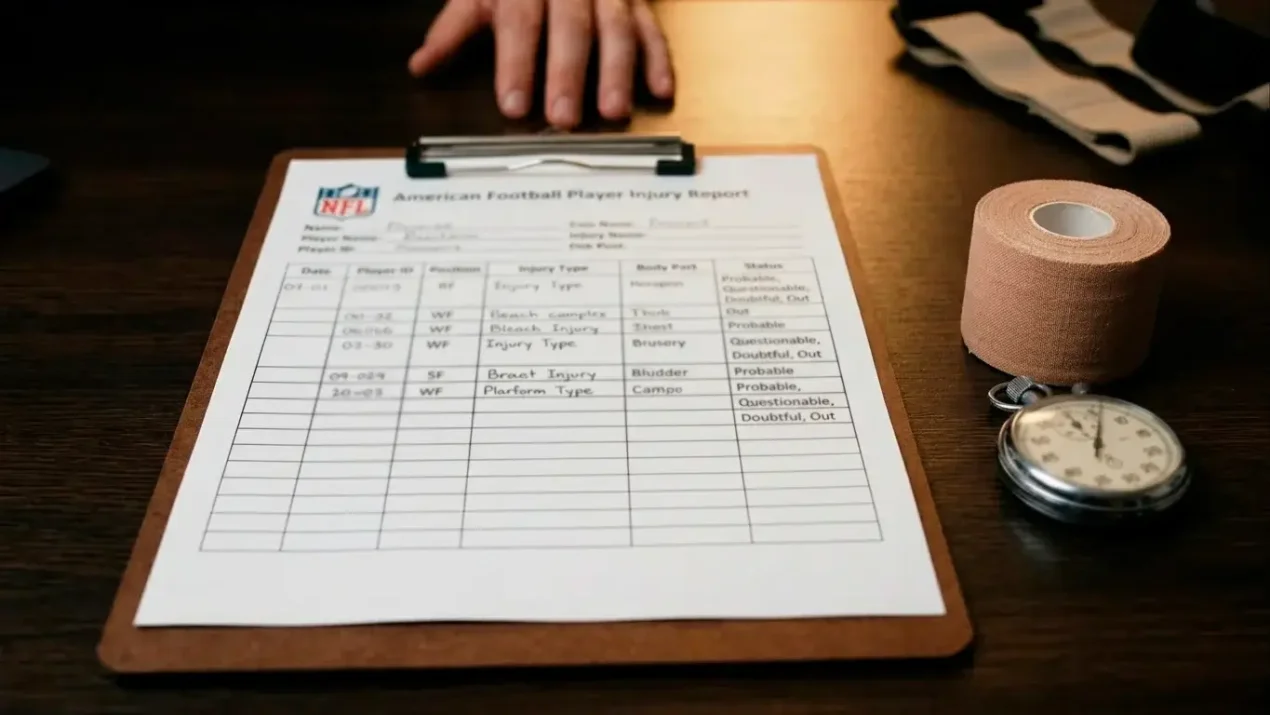
Friday NFL Injury Report Impact on Prop Lines
Years ago I fired a comfortable chunk on a receiving-yards over for a player listed questionable on Friday. He played. He saw four snaps in the first quarter, jogged off, did not return. My bet did not lose because the line was forgiving and his replacement had a brutal day, but I cashed by accident, and accidental cashes are how you train yourself to think badly about a market. That night I started keeping a spreadsheet on every player I had bet who was carrying an injury designation. Two seasons later, the spreadsheet had taught me something the bookmakers had clearly already internalised: the words on the injury report do not mean what most punters think they mean.
What follows is the working framework I now use. None of it is exotic. It is just the unglamorous business of reading the language carefully and learning what the league’s classification actually maps to on the field.
The four-word vocabulary every prop bettor needs
The NFL injury report uses four practice-participation tags and three game-status tags. The practice tags are “Did Not Participate” (DNP), “Limited Participation” (LP), “Full Participation” (FP) and “Veteran Rest Day”. The game-status tags are “Questionable”, “Doubtful” and “Out”. Each tag is a probability statement dressed up as a category.
Historical analysis across multiple seasons gives me these working approximations. A player listed “Questionable” suits up roughly 70% of the time. “Doubtful” lands around 25%. “Out” is functionally certain at zero. The practice tags carry their own information layer: a player who is DNP-DNP-DNP across Wednesday, Thursday and Friday is rarely active even if his game-status tag is “Questionable”, while a player who is LP-LP-FP is almost always available.
What this matters for, on the prop board, is that the implied probability of play affects line construction. A standard receiving-yards line is built on the assumption the player is at something like 95% expected snap share. If a starting wide receiver carries an LP-LP-LP designation across the week, his line is functionally already discounted by 5 to 8% – books are pricing in elevated injury risk. That has implications for which side of the line carries the real value.
Status versus snap count is where the money lives
Knowing a player is going to play tells you very little. Knowing how much he is going to play tells you almost everything. The relationship between injury designation and actual snap share is one of the most consistently mispriced dynamics in prop betting.
From the working data: a “Questionable” running back with a soft-tissue injury who plays averages roughly 78% of his usual snap share. A “Questionable” wide receiver with the same designation averages closer to 85%. The difference matters because rushing-attempt lines are tightly coupled to snap share, while receiving-yards lines are less so – a wide receiver running 18 routes in 85% of his usual snaps still has a realistic chance of hitting a yardage total, but a running back getting 14 carries instead of 19 has lost his over almost arithmetically.
Quarterbacks are the cleanest case. A “Questionable” QB who suits up plays virtually every snap or none – there is no middle position. His passing-yards line is therefore either fully in play or void, depending on bookmaker rules. The risk for a prop bettor is not partial play; it is the binary scratch.
Tight ends are the messiest. The position carries blocking responsibilities that can be redistributed when a player is limited, so a TE on the injury report can lose 30% of his snap share to a blocking specialist without anyone outside the building noticing. Reception lines on banged-up tight ends are, in my view, the single most reliably mispriced segment of the UK prop board. Books undervalue the snap-share risk relative to the headline game-status tag.
How prop lines react to a status change
The price action when an injury status shifts is mechanical and predictable once you have watched it happen a hundred times. A player goes from “Limited” on Thursday to “Doubtful” on Friday: receiving-yards lines drop 4 to 7 yards, anytime TD prices lengthen meaningfully, and replacement players have their lines tightened within minutes. Pickswise analysts tracking the regular season plus Wild Card, Divisional and Conference Championship rounds finished with 59 winning player props and +7.7 units of profit, and a meaningful chunk of that ledger sat on top of getting the post-status-change repricing right.
UK books reprice at different speeds. The biggest operators are quickest – usually within 90 seconds of the league’s official update. Mid-tier operators take five to fifteen minutes. Smaller books can lag by 30 minutes or more. That lag is where line shopping during the week genuinely pays. If you have accounts at three UK operators and you see a status downgrade hit the wires, the second-and-third-quickest books to reprice will have lines visibly out of sync with the new reality for a meaningful window. Standard prop line ranges of 250 to 300 passing yards for a starting QB, 3.5 to 7.5 receptions for a starting wideout, can move several full yards or half a reception within that lag window.
What I avoid is reacting on rumour. Beat-reporter tweets are not status changes. They are status predictions. Bookmakers will not move lines on a rumour – they wait for the league update – but they will tighten limits, which is functionally a soft move. If you see limits tighten without a price change, that is the book telling you something is coming. Sometimes it arrives; sometimes it does not. I do not bet that signal directly, but I read it.
Friday afternoon versus Saturday morning is when the real action happens
Every prop bettor I know spends Sunday morning glued to inactives. Fewer pay enough attention to Friday afternoon and Saturday morning, which is where the meaningful line movement actually concentrates for non-London Sunday fixtures.
Friday is when the official game-status tags are first attached to the practice report. Wednesday and Thursday have practice participation only. Friday adds “Questionable / Doubtful / Out”. The lines on a player whose first game-status designation appears on Friday at 16:00 ET will move within an hour of that release. UK books are open and trading, but the volume in the UK at that hour is light. The lines reflect the US market response.
Saturday morning is the cleanup window. New information has been digested overnight. Lines stabilise. UK punters waking up Saturday have access to lines that are, in my experience, close to optimally priced for the information available. The window between Saturday afternoon and Sunday morning is the lowest-edge period of the week – books are sharp, public action is heavy, and the soft numbers have been bid away.
The exception, again, is the late scratch. Inactives drop 90 minutes before kick-off, and the chaos pricing in that window is structurally different from the rest of the week. If you have done your homework on a depth chart, that window is where the work pays.
Reading the season-long pattern, not the week-by-week noise
One thing I have learned is that some players show up on the injury report habitually without it meaning anything. Veterans nursing chronic conditions log limited practices every Wednesday and full practices every Friday for fifteen consecutive weeks. Their prop lines are not meaningfully affected, nor should they be. The injury report is information, but it is information against a baseline, and the baseline is different for every player.
What I now do at the start of every season is build a quick reference list of “habitual designation” players – the receivers and pass rushers and quarterbacks who carry tags every week without it predicting anything about playing time. When one of those players shows up on the report, I ignore it. When a player who never shows up appears, I pay attention. The signal-to-noise ratio improves enormously once you stop treating every Wednesday “limited” as a data point.
The same principle applies to position groups. Running backs are more injury-volatile than wide receivers. Wide receivers are more volatile than tight ends. Quarterbacks are the most stable until they are not, at which point the volatility is total. Calibrating my response to a status change by position has, more than any other adjustment I have made, improved my prop hit rate on injury-affected players.
What snap-share percentage do ‘questionable’ players historically log when they play?
It depends on position. A ‘questionable’ running back who suits up averages around 78% of his usual snap share. A ‘questionable’ wide receiver averages closer to 85%. Tight ends sit somewhere in between but with much more variance because blocking work can be reassigned silently. Quarterbacks are functionally binary – they play virtually every snap or none, with no real middle ground.
How fast do UK bookmakers reprice props after an out tag is confirmed?
The biggest UK operators reprice within about 90 seconds of the league’s official downgrade to ‘out’. Mid-tier operators take five to fifteen minutes. Smaller operators can lag by 30 minutes or more. That lag is the practical case for keeping accounts at multiple UK books – when a status confirmation drops on Saturday or Sunday morning, the slower books carry stale lines on the affected player’s replacement for a real window.
If injury volatility on the passing side is what worries you most, the next read is a focused look at how to construct a passing-yards prop strategy that accounts for these status shifts.
This material was created by the YardLedger team.
Related posts

Passing Yards Prop Strategy for NFL: Reading Lines, Pace and Defensive Context
NFL RB Committee Prop Strategy: How to Bet Backfields That Refuse to Anoint a Workhorse