NFL Live Betting and In-Game Prop Markets
 Available in US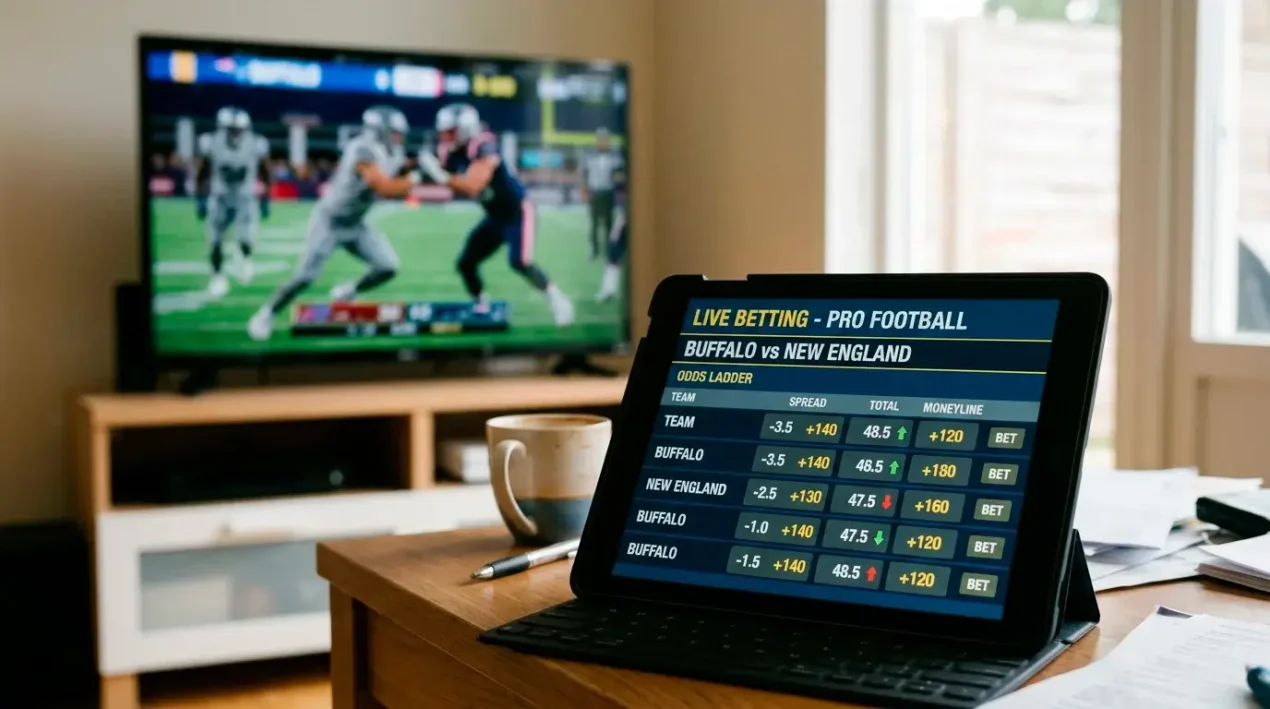
Maximizing In-Game NFL Market Value Before the Two-Minute Warning
A few seasons ago I was watching a Sunday afternoon AFC matchup where I had bet the over on the total at 47.5 pre-game. By the two-minute warning of the first half the score was 14-3. The total had compressed substantially in the live market, with the over offered at +175 versus my pre-game -110. I doubled my position at +175. Both teams accelerated their offences in the second half, the game closed at 31-27, and the live position cashed at a meaningfully larger return than my pre-game bet on the same outcome. The combined position returned more than three times what the single pre-game bet would have returned standalone.
That experience reshaped how I think about live betting. The pre-game line is a single price point on a continuously updating probability curve. The live market reprices that probability every few seconds based on what is actually happening on the field. For a UK punter with a clear pre-game view, the live market is not a separate product – it is an extension of the pre-game work, with prices that can be substantially better than the original offering depending on how the early-game flow develops.
In-play markets often provide significantly better value when you are looking to back an anytime touchdown scorer after a slow opening drive.
The live market structure on UK books
The live betting product on UK books for NFL games typically includes the moneyline, spread, total, and a rotating set of player props that refresh between drives. The most actively repriced markets are the moneyline and total, which update on every score and most significant possession changes. The spread market reprices on similar triggers but with slightly more lag. Player props update between drives, with the lines reflecting current production relative to the original pre-game line.
The pricing mechanism for live markets is essentially a continuous algorithm that takes current score, time remaining, possession, field position, and game-flow indicators (recent yards per play, recent third-down conversion rate) and produces an updated probability for the outcome in question. The algorithm is more sophisticated than most casual punters assume, but it operates on a set of standard inputs that have known limitations. The limitations are where the edge for the live bettor lives.
The 2025 international games drew average viewership of 6.2 million across NFL Network broadcasts, a 32% increase on the prior year. The growth has been driven heavily by live engagement, with UK fans watching the second halves of late-window Sunday games while live markets are active. Henry Hodgson, the NFL UK GM, framed the trajectory: “There’s a lot of growth, and the UK is at the centre of that international growth as well.” That growth has expanded the live market depth without yet fully compressing the inefficiencies, which leaves room for a disciplined bettor.
The mid-game pricing gaps that consistently appear
The cleanest live betting edge comes from prices that overcorrect to the most recent score. After a turnover-driven touchdown, the live moneyline on the trailing team can drop sharply – sometimes by 10 to 15% in implied probability – even though the actual game has 30-plus minutes remaining and one defensive score is not enough to fundamentally change the underlying matchup. The market overreaction creates value on the trailing team’s moneyline, especially when the pre-game read was that they were the better team.
The same pattern appears on totals. A scoreless first quarter compresses the over price substantially, even though the offences have had only 8 to 12 possessions between them and the second-half scoring rate is largely independent of the first-quarter rate. The over on the total after a slow first quarter is often available at +130 to +150 when the underlying offensive matchup still supports a 50%-plus probability of clearing the total. The Pickswise prop ledger that ran to 59 winning props and +7.7 units across the regular season and playoffs included multiple plays of exactly this structural type.
The third consistent gap is in player prop adjustments. A WR1 who has 12 yards through the first quarter sees his receiving-yards live line drop from 75.5 to 55.5 or lower. The market is responding to the slow start, but the player’s projected route share and target volume have not changed. If your pre-game read was that the receiver was undervalued at 75.5, your live read at 55.5 is even stronger – same player, same matchup, longer remaining game time. The under bet against this scenario is the symmetrical play when the pre-game projection was lower than the line.
The two-minute drill and end-of-half pricing
The end of the second quarter creates the most predictable live betting window of any NFL game. Teams that score going into halftime tend to come out and score again on the opening drive of the third quarter, a phenomenon sometimes called the “double-up” effect. The live total often reprices upward after a late-second-quarter touchdown, but not always by enough to reflect the elevated post-halftime scoring probability.
The pre-halftime live spread market is the cleanest end-of-half opportunity. A team that has been driving the ball effectively but is down 14-10 with two minutes to play in the half is a higher probability to cover the closing spread than the live market typically implies. The reason is that the team is positioned for two-minute drill points, then likely receives the second-half kickoff (in a typical scenario) for a back-to-back scoring opportunity. The live spread on the trailing team in this scenario tends to lag the actual second-half probability by 5 to 8%.
The end-of-fourth-quarter live market behaves differently. The probability calculations become more discrete – specific drive outcomes have outsized weight, and the algorithm’s continuous-flow logic loses some of its predictive power. The clean end-game plays are typically on the moneyline of trailing teams that have remaining timeouts and are within one possession with five-plus minutes left. The implied probability on these spots is often slightly below the true probability because the algorithm under-weights the value of remaining timeouts in tight finishes.
The live player prop and adjustment timing
Live player prop markets refresh between drives, which creates a specific timing rhythm for UK bettors who want to play them. The optimal window to place a live player prop bet is in the 30-second period after the prop has refreshed and before the next play begins. The line has incorporated the most recent drive’s events, but is about to begin updating based on the next series. If the next series produces an unexpected outcome – a fumble, a long completion, an injury – the line will move sharply, and the punter who has just placed their bet captures the move on the right side.
The live player prop market is also where injury-driven mid-game adjustments create the largest line dislocations. A WR1 who gets banged up in the second quarter and the team starts elevating a backup sees the backup’s live prop ladder shift dramatically – sometimes 15 to 25 yards on the receiving-yards line – within a single drive. The market is reactive, but the speed of the adjustment varies by operator. Some UK books update prop ladders within 60 seconds of a status change; others lag by several minutes.
The Sky Sports coverage renewal for 2025/26, with a 50% increase in NFL programming, has improved UK viewership access during the live windows. Laura Louisy, anchor of Sky’s NFL coverage, framed the depth proposition: “It allows us to do so much more for those fans of the sport that are dedicated and want more depth.” The implication for live bettors is that game broadcasts now provide enough real-time injury reporting and play-by-play context to inform live prop decisions on the fly, which was less true a few seasons ago.
The cash-out integration with live betting
The cash-out function on pre-game bets is the inverse side of the live market. A pre-game bet that is heading in your direction can be cashed out at the current live-implied probability, locking in a partial profit. A pre-game bet that is heading against you can be cashed out at a partial loss rather than ridden to settlement. The cash-out price is determined by the same live-market algorithm that prices new bets.
The strategic integration of cash-out and live betting is what separates disciplined live bettors from speculative ones. A pre-game over bet on the total that is heading positive after a high-scoring first half can be cashed out for 65 to 75% of the maximum return, depending on the live-market dynamics. The alternative is to hold the position and accept the variance of the remaining halves. The right answer depends on the punter’s read on the second-half flow and on the size of the remaining edge.
The combined cash-out plus live bet structure creates a four-quadrant decision matrix. Pre-game bet trending positive plus high confidence in continued movement: hold the position. Pre-game bet trending positive plus low confidence: cash out partial. Pre-game bet trending negative plus high confidence in reversal: hold and possibly add. Pre-game bet trending negative plus low confidence: cash out to limit loss. The discipline is making the call based on the live-market read rather than emotional reactions to the early game state.
The UK-specific live betting workflow
The Sunday afternoon and evening UK kick-off windows create a specific rhythm for live betting. The 6 p.m. UK kick-offs run alongside the early US window, which means UK punters are live betting their pre-game positions while also evaluating live spots in other games. The 9:25 p.m. UK kick-offs correspond to the late US window, by which time UK punters have settled their early-window outcomes and are focused on a single late game.
Stay ahead of the bookmakers by using the live data available on our dedicated NFL player bets platform.
My personal live betting discipline: I commit to live positions only in games where I had a clear pre-game view. The live market is not a place to develop a new read on a game I have not analysed – the algorithm’s information advantage over me would be too large. Where I have a pre-game view, the live market becomes an opportunity to add to a winning position at better odds, hedge a losing position at acceptable cost, or pick off price overcorrections after specific events.
The Sunday slate workflow accommodates this. I run my pre-game analysis on Friday and Saturday. I lock pre-game bets on Saturday evening or Sunday morning. During Sunday afternoon, I monitor live markets for prices on the same games where I have pre-game positions, looking specifically for the overcorrection windows after first-quarter slow starts, after turnover-driven scores, or after key injury developments. The live additions are sized at 50 to 75% of the pre-game position size, because the live market is more reactive and the time decay of edge is sharper.
What’s the best live NFL betting market for UK punters during Sunday afternoon games?
The total over after a slow-scoring first half is one of the most consistently mispriced live markets. The live algorithm overcompresses the over price after a 7-3 or 10-7 first half, even though the second-half scoring rate is largely independent of first-half pace. The implied probability often sits 5 to 10 percentage points below the true probability when the pre-game total projection was based on offensive matchup quality rather than recent results. The second cleanest market is the trailing-team moneyline after a turnover-driven score, where the live market overreacts to the immediate scoring event.
Should I use cash-out alongside live NFL betting on UK books?
Cash-out and live betting are complementary tools rather than alternatives. The combined approach is most powerful for a pre-game position trending in the wrong direction: cash out a portion to lock in a smaller loss, then evaluate the live market for a fresh position at the new live price if your read on the remaining game still supports the original directional view. The discipline is to treat each decision separately rather than chasing the original bet by doubling down. Cash-out for protection, live bet for opportunity, and treat them as distinct decisions on the same game.
If live betting sharpens your interest in markets where managing position size and timing matters most, the related read is the framework for bankroll management across multiple NFL betting markets.
This material was created by the YardLedger team.
Related posts
Passing Yards Prop Strategy for NFL: Reading Lines, Pace and Defensive Context
NFL RB Committee Prop Strategy: How to Bet Backfields That Refuse to Anoint a Workhorse