NFL Alt Lines Strategy and Alternate Prop Ladders
 Available in US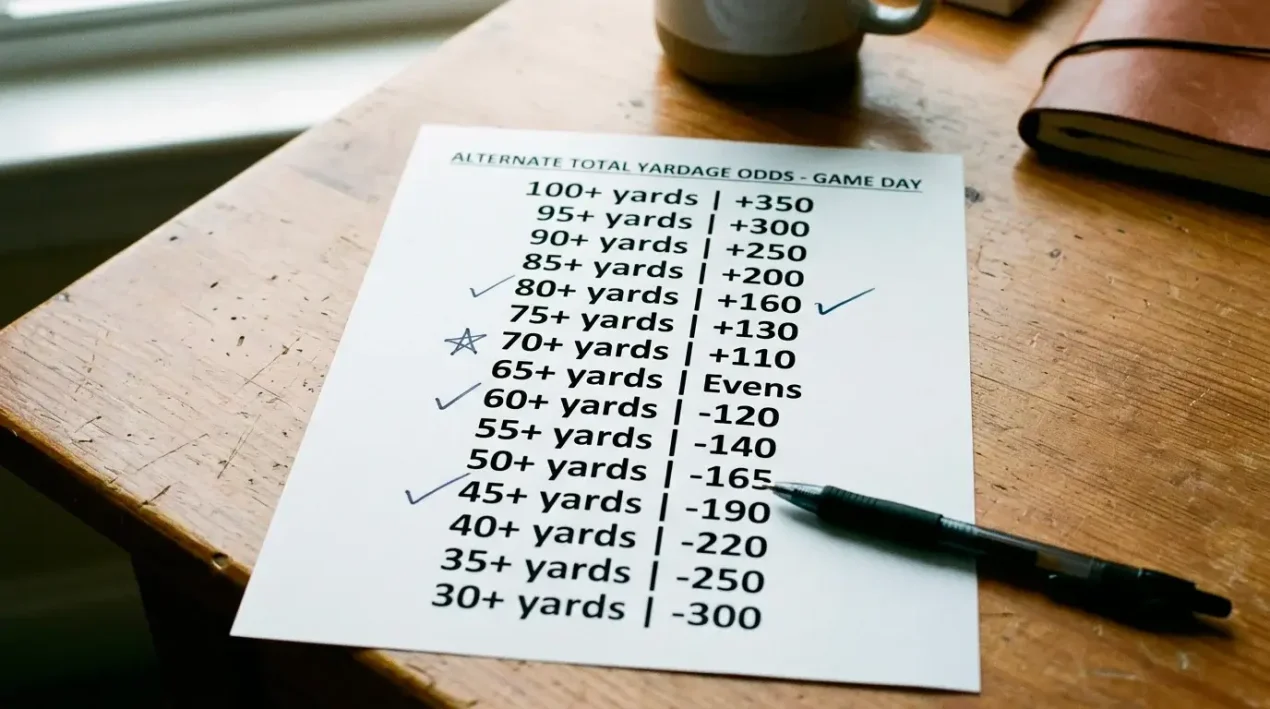
Splitting Stakes Across Alternate Passing Prop Ladders
One Sunday last season I had what I considered a strong read on a QB’s passing yards. The standard line was 268.5, offered at -110 over and under. My projection landed at 305 to 320 yards based on the matchup, weather, and snap-count projections. Rather than just betting the over, I spread the stake across four alt lines: 275.5 at -125, 285.5 at +110, 295.5 at +145, and 305.5 at +200. The QB threw for 318. Three of the four alt lines cashed, the fourth was a near-miss, and the net return on the four-bet combination was 31% higher than betting the same total stake on the standard over alone.
That outing was not unusual. Alt-line ladders are one of the most under-utilised tools available to UK NFL prop bettors. They let you express a directional view at a granular level, capture more of the upside when your projection lands in the right tail, and shape the variance profile of a position to match your conviction. The casual punter takes the standard line at -110 and moves on. The disciplined punter treats the alt-line ladder as a menu of options and chooses the combination that maximises expected value for the read.
How alt-line ladders are constructed
The alt-line ladder for a passing-yards prop typically offers thresholds at 10-to-15-yard intervals above and below the standard line. The standard line carries the smallest payout (typically -110 either side), and each step away from the standard line increases the payout to reflect the lower implied probability of clearing the new threshold. A QB with a standard line at 268.5 might have alt lines at 250.5, 260.5, 278.5, 288.5, 298.5, and so on up to 320.5 or beyond.
The pricing follows a roughly continuous probability curve, but bookmakers add margin at each step that compounds across the ladder. The implied probability at the standard line, with -110 on both sides, prices about 52.4% each way after vig. The implied probability at the 278.5 alt line might be 44%, at 288.5 might be 36%, at 298.5 might be 28%, and at 308.5 might be 21%. The cumulative margin across multiple steps means alt lines are slightly more expensive in implied-probability terms than the standard line is, but the trade-off is the ability to express a precise view rather than a binary one.
The ladder construction varies by market type. QB passing yards typically has the widest and most granular ladder. Receiving yards has a tighter ladder, usually 5-yard increments. Rushing yards has medium granularity, often 7-to-10-yard increments. Anytime-TD and longest-play markets have parallel alt-line products (longest pass over 35, 40, 45, 50 yards) that follow different pricing logic from the yardage ladders.
When alt-line strategy beats the standard line
The alt-line strategy adds value when your projection differs from the standard line by enough that the alt-line payout improvement outweighs the vig cost. The decision rule I use: if my projection is at least 10% of the standard line above or below the offered number, the alt line at the closest threshold is usually a better expected-value bet than the standard line. If the projection differs by 15% or more, spreading across two or three alt lines captures more of the variance profile.
A QB at a standard 268.5 line with my projection at 305: that is a 13% upward deviation, well into alt-line territory. The 278.5 alt at -125 implies a 56% probability, but my projection has the over hitting at perhaps 65%. The 288.5 alt at +110 implies a 48% probability, but my projection has it hitting at perhaps 58%. The 298.5 alt at +145 implies a 41% probability, but my projection has it hitting at perhaps 50%. Each of those three alts represents positive expected value for the same underlying read. Spreading the stake across them captures more of the value than concentrating on one threshold.
The Pickswise prop ledger that ran to 59 winning props and +7.7 units across the regular season, wild card, divisional and conference rounds included a number of plays that were specifically constructed on alt-line ladders rather than standard lines. The structural pattern was that alt-line spreading produced higher ROI per stake than concentrated single-line plays when the projection was confident and substantially different from the standard offering.
The under-side alt-line problem
Alt-line strategy on the under side has structurally different economics from the over side. The under alt-line ladder runs in the direction of zero, which means each step down increases the price (e.g., from -110 at the standard line to +110, +135, +175 as the threshold drops) but also corresponds to a lower true probability. The under alt lines are theoretically symmetric to over alt lines, but in practice the margin is often slightly larger on the under side because public money flows more heavily to overs on most prop markets.
The practical implication is that under alt-line plays should clear a slightly higher edge bar to be worth betting. The over alt at +145 with a true probability of 50% offers value of about 5.5% per stake. The under alt at +145 with a true probability of 50% should offer comparable structural value, but in practice the margin built into the under side narrows the realised edge. The break-even hit rate on under alt lines is typically 1 to 2 percentage points higher than the equivalent over alt line at the same price.
The clean exception to this is the deep under alt – the threshold set so low that even a poor performance clears it. The “QB passes for at least 175.5 yards” type of under at -150 or shorter is essentially an insurance product, with a high hit rate and modest return per stake. These can be combined with high-conviction overs as parlay legs to boost the parlay multiplier without meaningfully increasing the probability of total ticket failure.
The longest-play alt-line market
Longest-play alt lines exist for passing, rushing, receiving and even kicking-game markets. The longest pass alt typically runs in 5-yard increments from 30 yards up to 60 yards. The longest rush alt runs in similar increments. Longest reception alt lines work the same way. These markets have a different probability structure from yardage markets because they depend on a single best-case outcome rather than aggregate volume.
A QB throws 32 passes in a typical game. The probability of at least one pass going for 30-plus yards is high (around 75% for most starting QBs). The probability of at least one going for 40-plus is around 50%. For 50-plus it drops to around 30%. For 60-plus it is around 15%. The market typically prices these reasonably, but the per-attempt distribution varies meaningfully by offence – a vertical-passing offence has a steeper right tail and a higher longest-pass probability than a short-passing offence, even at similar total passing yards.
The longest-rush alt is where the most consistent UK book mispricing appears, for both running backs and mobile QBs. The market often does not differentiate enough between offences that produce home-run runs (zone-blocking schemes with breakaway speed in the backfield) and offences that produce consistent grinding runs (gap-scheme power running games). The longest-rush over at 25-plus or 30-plus yards on a breakaway-speed back in a zone-scheme offence is often priced as if the back were a comparable-volume grinder, which leaves consistent value on the over side.
The receiving-yards alt-line specific edge
Receiving-yards alt lines for top wide receivers are typically the tightest market in the alt-line category, because the casual public money flows heavily into WR1 markets and the operators tighten the pricing accordingly. The alt-line ladder for a Justin Jefferson or Tyreek Hill type receiver is usually well-calibrated to the underlying probability distribution.
The structural value tilts toward the WR2 and WR3 alt ladders, where the casual money is less concentrated and the matchup-specific factors are less efficiently priced. A WR2 with a standard line of 52.5 yards and an alt ladder that runs to 80.5 yards can be sharply mispriced in matchups where the script favours secondary receiver volume – for instance, when the opposing defence shadows the WR1 with their top cornerback and leaves the WR2 against the second corner.
The 2025 international games drew average viewership of 6.2 million across NFL Network broadcasts, a 32% increase year over year, which has accelerated UK punter attention on the headline WR1 names. Henry Hodgson, the NFL UK GM, has framed the broader engagement growth: “There’s a lot of growth, and the UK is at the centre of that international growth as well.” That attention concentrates on the most-famous receivers, which leaves the WR2 and WR3 alt-line markets relatively soft for the analytical bettor.
Stake construction for alt-line ladders
The practical question for any alt-line strategy is how to size across the multiple thresholds. My default approach is the “decay-weighted” allocation: largest stake on the closest alt line to the standard, smaller stakes on each step further out. For a passing-yards ladder where I project the QB substantially above the standard line, I might allocate 50% of the position to the closest alt, 30% to the next, and 20% to the most aggressive alt. The total stake equals what I would have bet on the standard line alone.
The result is a payoff structure that rewards the projection landing where I expected (multiple alts cash, weighted toward the most likely thresholds) while still capturing meaningful upside if the projection lands in the right tail (the most aggressive alt cashes at the longest price). The decay weighting reflects my actual confidence distribution rather than treating each alt as an equally likely outcome.
The variance profile of an alt-line ladder is meaningfully different from a single-line bet. The single line is binary: win or lose at fixed odds. The ladder produces a distribution of outcomes: zero alts cash (worst case), one cashes, two cash, three cash, all cash (best case). The expected value calculation is the sum across each scenario weighted by probability. If your projection is correct, the ladder almost always returns positive value across the position, even when not every alt cashes. The skill is calibrating the ladder shape to your confidence in the projection – wider spreads when confidence is moderate, tighter spreads when confidence is high.
When should I use alt-line strategy instead of betting the standard NFL prop line?
The trigger is when your projection differs from the standard line by enough that the closest alt line offers better expected value at its longer price. The rough rule is a 10% deviation in either direction – if your projection on a QB passing-yards line is at least 10% above the standard, the next alt line up usually represents better value than the standard over. The structure compounds: if the deviation is 15% or larger, spreading across two or three alt thresholds captures more of the upside than betting any single line.
Is the under side of alt-line ladders worth playing on UK NFL props?
Selectively. The under alt-line ladder has slightly less favourable margin than the over side on most UK books because public money flows more heavily to overs and operators price the under side more cautiously. The cleanest under alt-line plays are deep insurance plays at short prices (-150 or shorter), which can serve as parlay legs in same-game parlays or as standalone insurance positions. Under alt-line plays at long prices need a meaningfully higher projected edge to overcome the slightly heavier margin built into the under-side ladder.
If alt-line thinking sharpens your interest in markets where line shopping converts theoretical edge into actual P&L, the related read is the systematic framework for line shopping across UK NFL operators.
This material was created by the YardLedger team.
Related posts

Passing Yards Prop Strategy for NFL: Reading Lines, Pace and Defensive Context

NFL RB Committee Prop Strategy: How to Bet Backfields That Refuse to Anoint a Workhorse