NFL Kicker Props: Field Goals and Total Points
 Available in US
Exploiting the 1.5 Field Goals Made Prop Line
For most of my first season betting NFL seriously, I ignored kicker props entirely. They felt like a sideshow market – pennies on big bets, low ceilings, and not worth the analytical effort. Then I started tracking my Sunday slate and noticed something embarrassing. The bets I had skipped – kicker field-goals-made overs on home teams in domes hosting solid-but-not-great offences – had a hit rate north of 65%. Three consecutive weeks of paper-tracking returned 14 of 18 winners. I had been ignoring one of the most reliable structurally-edged markets on the UK book.
What I had not understood is that kicker props are one of the few NFL markets where the line is constrained by stadium and matchup variables that bookmakers price conservatively because casual punter volume is low. The market is thin, the analytical inputs are knowable, and the dispersion of outcomes is smaller than for skill-position props. Once I started taking it seriously, kicker props became one of the steadiest contributors to my season-long P&L.
The two markets that matter most
The UK kicker prop market typically offers three product types: total field goals made (most common, usually offered at 1.5 or 2.5), total kicker points (combining field goals and extra points, usually 7.5 to 9.5), and longest field goal made (alt line, usually 35 to 50 yards). The first two are where the bulk of betting volume goes, and they are also where the analytical work pays the cleanest dividends.
The field-goals-made line behaves differently depending on the projected team total and the offensive scoring style. A team projected to score 24 points can get there in many ways – three TDs and a field goal (3 FGs implied count would be wrong), three TDs and three extra points (only one FG attempt likely), two TDs and three FGs (over on 1.5 cleared), or any combination that lands at 24. The right way to think about field goals made is not “how many points will the team score” but “how many of those scoring drives will end at the 12-to-25-yard-line spot where the field goal becomes the choice”.
The total kicker points line aggregates field goals and extra points. The key insight is that extra points are nearly automatic – the league-wide make rate is around 94% – so the kicker points line is essentially “how many touchdowns will the team score, times one, plus how many field goals, times three”. A 1.5 field goals line plus an estimated 2.5 TDs gives you about 8 expected kicker points before adjusting for likelihood. The lines that move are the ones where the team total projection and the FG-attempt projection diverge.
Matchup factors that move the kicker line
The single most important matchup variable for kicker props is red-zone efficiency. Teams that drive deep but stall in the red zone produce more field goals. Teams that score touchdowns at a high rate in the red zone produce more extra points and fewer field goals. The league average red-zone TD rate is around 56%, which means about 44% of red-zone trips end in a field goal attempt. Teams above 65% red-zone TD rate are field-goal-made unders relative to the line; teams below 50% are overs.
The second variable is opposing defence’s red-zone strength. A defence that holds opponents to a high field-goal-attempt rate in the red zone (rather than allowing TDs) creates over conditions for the visiting kicker. Some defences are statistically excellent at goal-line stands but mediocre between the 20s, which is exactly the profile that maximises opposing kicker field-goal volume. The Pickswise prop ledger that ran to 59 winning props and +7.7 units across the regular season and three playoff rounds had a measurable contribution from this kind of “matchup-specific kicker over” play.
The third variable is the head coach’s fourth-down aggressiveness. Coaches who go for it on fourth down at a high rate reduce their kicker’s field-goal volume even when the team’s offensive efficiency would otherwise predict it. The “go for it” coaches typically have a 20% to 30% lower kicker FG attempt rate than the league-average coach at the same team-total projection. This is information that is freely available – coaching fourth-down decision tendencies are tracked publicly – and it consistently fails to move kicker prop lines at UK books in proportion to its actual effect.
Stadium and weather effects on kicker pricing
The kicker prop market is where weather effects compound most predictably. Dome teams at home produce more kicker points than outdoor teams at home, all else equal, because the environment is controlled. Outdoor games in winds above 15 mph see field-goal attempts reduced as coaches become more conservative on long attempts. Cold-weather games below freezing tighten kicker range, which means borderline attempts (45-plus yards) become coach decisions rather than automatic kicks.
The interesting wrinkle is that the field-goals-made under is rarely the right play in adverse weather, because the loss of long-range attempts is partially offset by an increase in red-zone field-goal conversions. A team that would normally go for it on fourth-and-two from the 7 in dry weather might kick the field goal in wet weather, because the alternative play is riskier. The net effect on field-goal volume in adverse conditions is closer to neutral than most punters assume, with a slight tilt toward more attempts in cold-plus-wet conditions.
Longer-range field-goal alt-line markets are where weather creates clean directional plays. A “kicker makes a 40-plus-yard FG” alt line in calm dome conditions has a base probability around 70% for a top-tier kicker. The same prop in 18 mph wind with the wind blowing across the kicking line drops to around 50% to 55%. The lines do not always adjust by the full amount, particularly on Saturday-night-set kicker prop ladders for Sunday afternoon games.
The international slate kicker angle
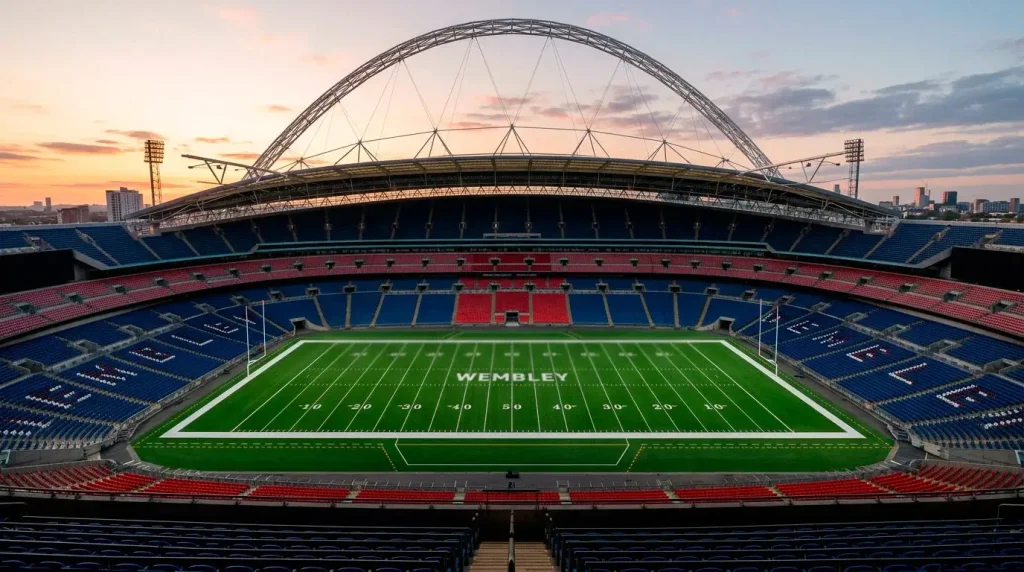
The international games create specific kicker betting dynamics. Wembley’s pitch, Tottenham Hotspur Stadium’s NFL configuration, and the Croke Park surface in Dublin all kick slightly differently from typical US NFL stadiums. The kickers who play these venues are working with surface variations and wind patterns they have not practised on, and the first-half kicker performance in international games is statistically slightly below league average across the historical sample.
The 2026 international slate of nine games adds Berlin, Madrid, Melbourne, Rio and Paris venues, all with their own surface and wind characteristics. The 2025 Wembley fixture drew 86,152 fans in conditions that involved meaningful crosswind across the goal-kicking line. Field-goal-made unders in international games, especially on kickers who have not previously played in the venue, are a structurally-tilted play. Laura Louisy, anchor of Sky Sports’ rolling NFL coverage, framed the UK fan progression in terms of deepening engagement: “It allows us to do so much more for those fans of the sport that are dedicated and want more depth.” Kicker props in international games are exactly the kind of depth that rewards the dedicated fan over the casual punter.
The compensating angle is that special-teams attention to the international venues has increased in recent seasons. Teams now scout the kicking conditions in advance, and beat-writer reporting on practice field-goal accuracy in the days before an international game has become a public data source. The under angle works best when the visiting kicker has not played the venue before and there is no reported pre-game adjustment for the conditions. When the team has scouted heavily and the kicker has had time to adjust, the structural edge tightens.
The longest-FG alt line that pays the best
Of all the kicker markets, the longest-field-goal-made alt line is the one with the most consistent UK book mispricing. The market typically lists alt thresholds at 5-yard intervals (35-plus, 40-plus, 45-plus, 50-plus yards), and the implied probabilities at each level are often calibrated for league-average kickers in neutral conditions. The actual kicker market is heavily bimodal – there are about 8 to 10 elite kickers with reliable 55-yard range, and another 15 to 20 kickers whose comfort zone tops out around 50.
The implication is that the 50-plus and 55-plus alt lines are sharply priced for elite kickers but mispriced for the second tier. A 55-plus-yard alt line offered at +600 on a second-tier kicker is roughly correct (the kicker has about a 12% chance of attempting and making a 55-plus). The same line offered at +400 on a top-tier kicker is closer to fair value, which is no edge.
The longest-FG over alt line is also where domed stadiums create their cleanest edge. Indoor kickers, with controlled conditions, attempt 50-plus yard field goals at a meaningfully higher rate than outdoor kickers because the operational range is wider and the coach’s confidence in the kicker is higher. The 50-plus yard alt line on a top-tier kicker in a dome, when offered at +250 or longer, is a structurally repeatable play across a season.
The bet selection workflow that consistently works
My Sunday morning kicker prop check is built around a four-input filter. First, projected team total: I look at games where the implied team total is between 18 and 27 points, which is the sweet spot for field-goal volume. Below 18, the team is not driving consistently enough to produce field-goal attempts; above 27, the offence is in the red zone often enough that TDs dominate over field goals. Second, head coach fourth-down aggressiveness. I skip kicker overs on the most aggressive go-for-it coaches and lean overs on the most conservative ones. Third, opposing defence red-zone strength. Defences ranked in the top 10 for red-zone TD prevention are kicker-over signals against them.
Fourth, stadium and weather. Dome games and calm-weather outdoor games are the cleanest kicker-over conditions. Outdoor games in 20-plus mph wind or below-freezing temperatures are unders, but selectively – the unders only work when the coaching profile and team total also align. The Pickswise season-long sample showed that kicker prop selectivity (taking only 4 to 6 kicker bets per Sunday, sized small, with all four filters aligned) produced a substantially better hit rate than blanket-betting every kicker prop on the slate.
The sizing discipline matters because kicker prop ceilings are limited. A field-goal-made over at -120 returns 83p on £1. The math says you need to hit at 54.5% to break even at that price, and at 60% you are running a profitable 5.5%-edge book. Kicker props will not deliver the variance-driven big wins of long-shot anytime-TD or longest-play markets. They will, if selected with discipline, deliver the consistent base-rate profitability that funds the variance plays on the rest of the card.
Which NFL kicker prop market offers the best value for UK punters?
The total field goals made line at 1.5 in dome stadiums hosting offences with strong red-zone field-goal-attempt profiles is the most consistent positive-EV market across the season. The longest field goal made alt line at 50-plus yards on top-tier kickers in dome stadiums is the second most reliable. Both markets benefit from the lower casual-punter volume on kicker props, which means UK operators do not always tighten the lines as aggressively as they do for skill-position markets.
How much should I bet on individual NFL kicker props?
Kicker prop bets should be sized as the steady-base layer of a Sunday slate rather than the variance-driven layer. A typical kicker-over hits at around 60% to 62% when filtered for matchup, weather, and coaching profile. That is a profitable rate at standard pricing, but the per-bet return is modest. Sizing at 1.5% to 2% of bankroll per kicker prop, with three to five well-filtered selections per week, is the rhythm that compounds steadily over a season without exposing too much capital to a single market.
If kicker selectivity sharpens your interest in markets where stadium and conditions drive consistent edges, the related read is the structural framework for defence and special teams prop markets on UK books.
This material was created by the YardLedger team.
Related posts

Passing Yards Prop Strategy for NFL: Reading Lines, Pace and Defensive Context
NFL RB Committee Prop Strategy: How to Bet Backfields That Refuse to Anoint a Workhorse